

The residential conversion of the former Pfizer headquarters at 235 East 42nd Street came to a harrowing halt yesterday morning when two support beams on the 21st story buckled, causing several upper floors to sag. Workers in the 33-story tower were evacuated along with occupants of multiple neighboring buildings after city officials deemed the structure at risk of collapse. In the evening, contractors began installing emergency shoring to prevent further damage to the building.
The 1,600-unit office-to-residential conversion began in 2024 and was set to become the largest project of its kind in US history. Work appeared to be progressing smoothly, with most of the new envelope in place at the time of our last update a month ago.
And while Metro Loft Development, which is leading the project along with David Werner Real Estate Investments, claimed in a statement to the New York Times that the “affected area is a small section” of the overall building, yesterday’s setback casts significant doubts on the future of the redevelopment.
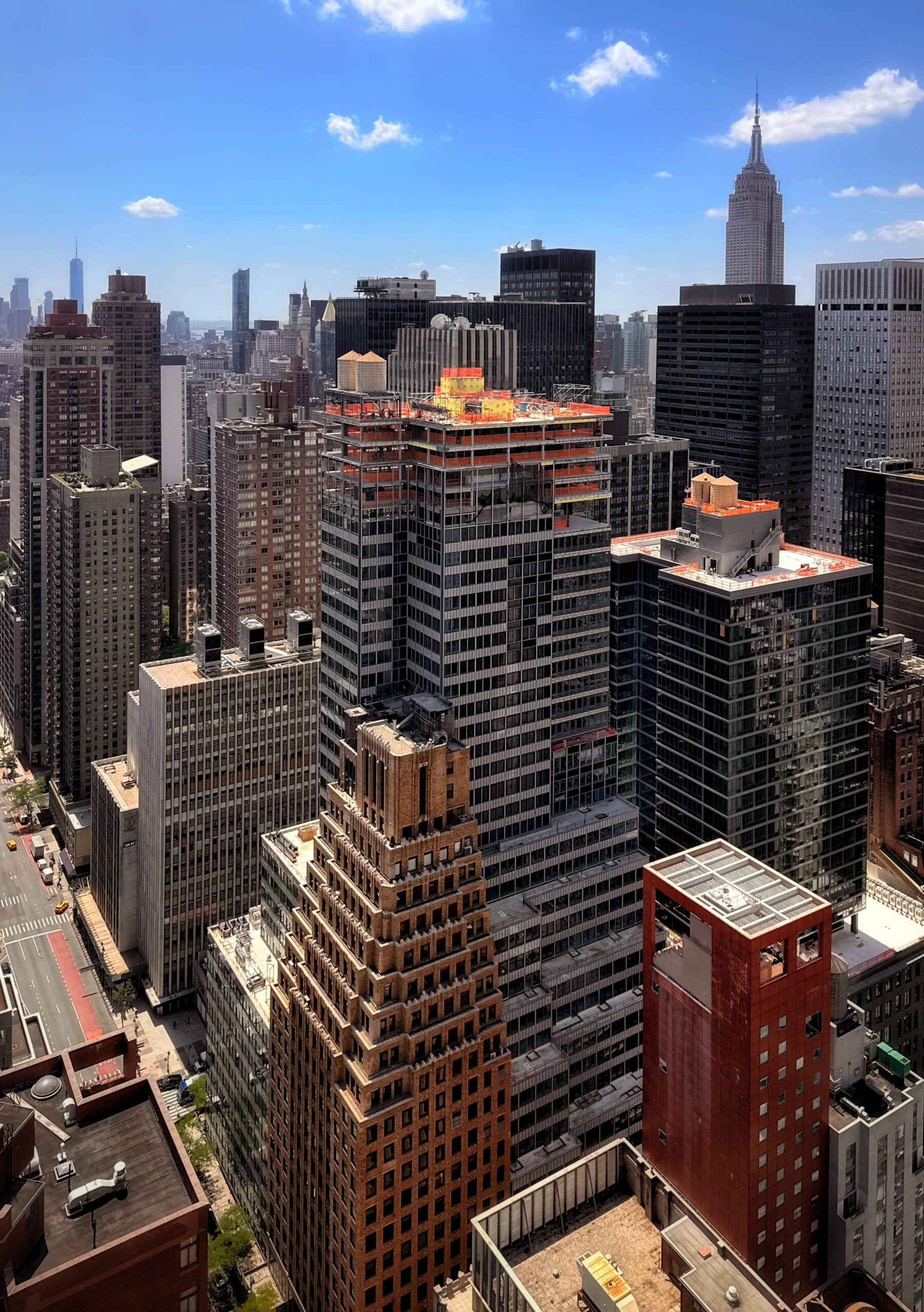
235 East 42nd Street. Photo by Michael Young.
It should not, however, cloud the prospects of further developments of its kind. Midtown and the Financial District have millions of square feet of underused office space, and conversions are one of the most practical ways to adding much-needed housing quicky. One incident at one building is not a reason to slow down the other projects like it.
But yesterday’s near-calamity should call attention to a much larger disaster that may be waiting to happen: The 670-foot condo tower that has been known to be leaning since 2019 and has simply been left standing at the Seaport.
Seaport Residences, formerly dubbed One Seaport, has been a blemish on the Lower Manhattan skyline for more than seven years, languishing in limbo as a concrete skeleton along the waterfront at 161 Maiden Lane. Developed by Fortis Property group, the skyscraper was planned to yield 80 condominium units, but since the discovery of its 3-inch vertical misalignment, there seems to be no feasible path to completion. And given its tenuous foundations, the structure poses a serious risk of catastrophic collapse.
The City of New York can’t afford to wait any longer. It’s time to do something about the Leaning Tower of Lower Manhattan.
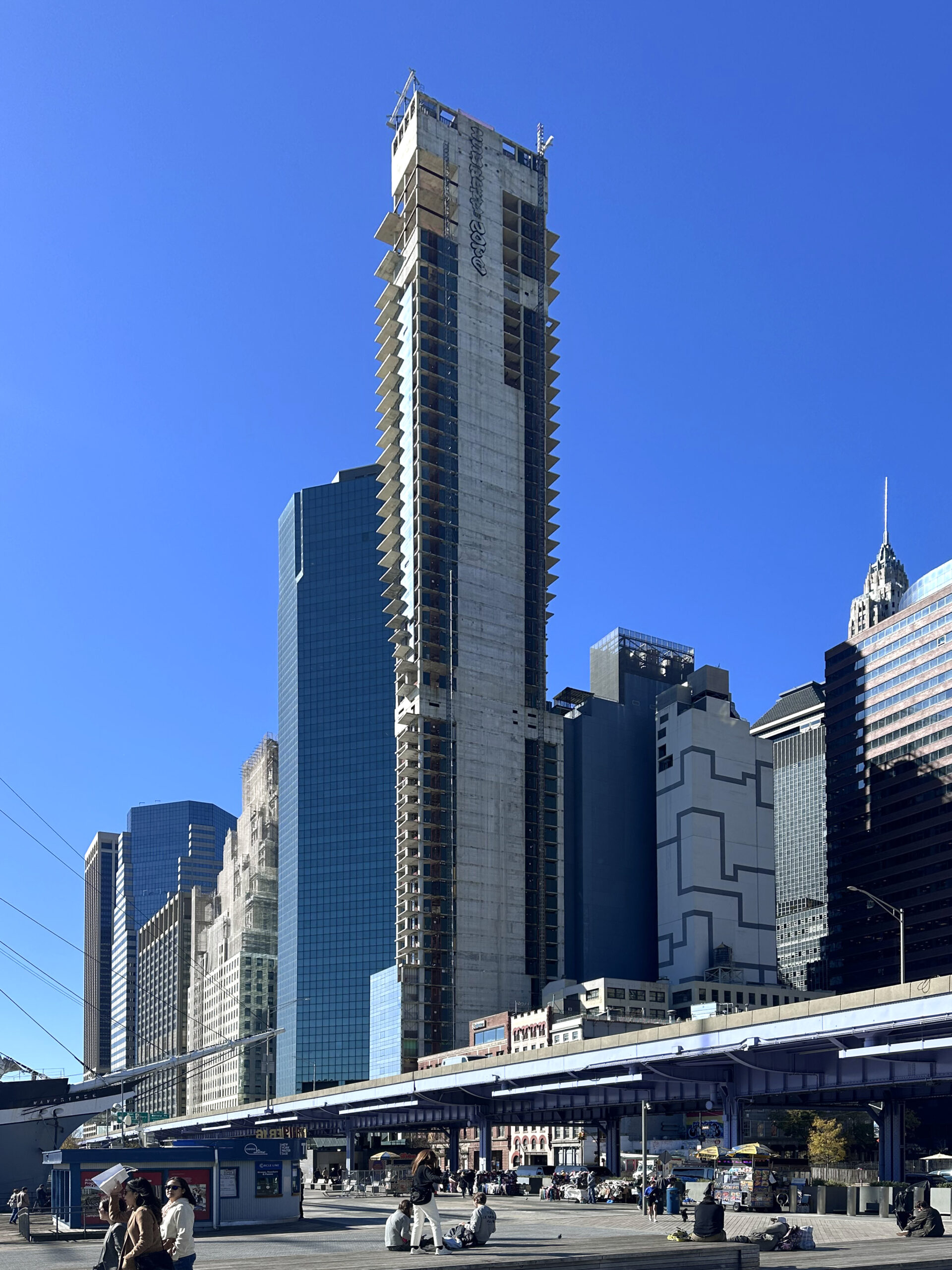
Seaport Residences, 161 Maiden Lane. Photo by Michael Young
Seaport Residences’ tilt is nearly impossible to correct, as any efforts would require an extremely costly excavation of its foundations—something that no one is willing to fund. Despite a 2019 survey by engineering firms Arup and WSP that deemed the skyscraper’s structural integrity to be sound, there are several indications that it may not be.
For one, Fortis allegedly forwent recommendations by the initial contractor, Pizzarotti, to use bedrock-anchored structural supports beneath the building’s foundations, instead opting for the less expensive practice of “soil improvement.” The foundations were essentially formed over shored-up dirt, which likely shifted during construction, causing the tower to lean. Fortis accused Pizzarotti of improperly poring the slab, but regardless of where the blame falls, the tower is built on unsteady ground. And since it shifted once, it’s conceivable that it could continue to do so.
Second, the assessment by Arup and WSP is now seven years old, and no more recent public accounting of the building’s condition appears to exist. If no further evaluations have been conducted, no one can know for sure whether the integrity has held.
Third, evidence exists that suggests it may not be holding. A 2024 post on the Reddit Skyscraper community claimed the tower is also leaning to the west, supported by photos that appear to show the western face of the building pressing against the upper levels of the adjacent hotel tower. The photos are unverified and Fortis has not addressed them. But if accurate, they serve as an alarming indication of a progressively worsening problem.

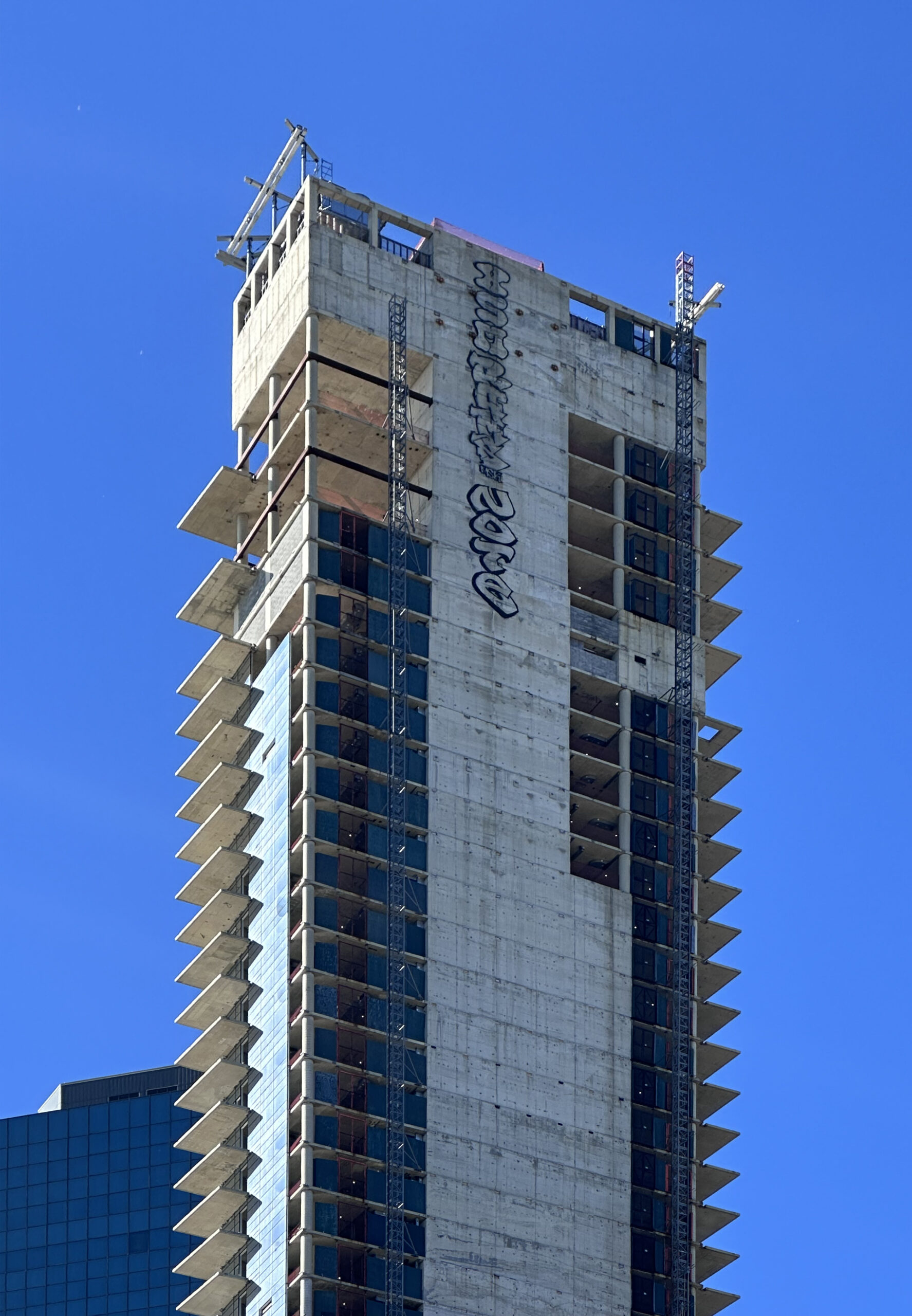
Seaport Residences, 161 Maiden Lane. Photo by Michael Young
Whatever the true state of the tilt, the building has sat exposed to the elements and unmonitored by any public record for the better part of a decade. That’s long enough. The city should require Fortis to commission a current structural survey, made public, before another year passes. If the tower is sound, Fortis should be forced to sell to a developer that can actually put the site to use—potentially as affordable housing, since it’s hard to imagine buyers lining up to pay condo prices to live in a tower with this much baggage.
And if the survey turns up what the Reddit photos suggest, the building should be demolished before its foundation problem becomes the City’s problem. Yesterday’s scare at the Pfizer conversion, bad as it was, involved a structure that has stood on solid ground for more than 65 years. A 670-foot tower coming down on the Seaport waterfront, on a foundation nobody has fully trusted since 2019, would be an order of magnitude worse.
Subscribe to YIMBY’s daily e-mail

Follow YIMBYgram for real-time photo updates
Like YIMBY on Facebook
Follow YIMBY’s Twitter for the latest in YIMBYnews
100% agree! This is exactly like the BQE situation- everyone is sitting on their hands, waiting for a catastrophic disaster to finally force a move. Litigation be damned. Waiting around for the courts to settle this ensures it’s going to end with a completely preventable loss of life.
The city should order an emergency demolition of the Seaport building and that of the additions to Pfizer. I was surprised they blocked traffic on 42nd St., but allowed the Flushing line to keep rumbling by.
Tear it down and arrest the contractor and the owner who skirted around safety.
I have to agree with you on both, and the demolition costs must be borne but the errant developer in their entirety. We need to set an example here. Consequences are the only possible way to prevent such recurrences.
*by the developer
💯,agree. Probably too late for anyone wanting to buy this building? It’s an eyesore in the city and a very dangerous one at that…
Ultimately its not the developer’s fault. Its the engineer on record who approved it. developers always try to cut costs, but if the EOR approved it, you cannot blame the developer for going with a cheaper option (then)considered “safe” by EOR.
Well said!
Oh, I’m sure all of this was completely intentional. The developer will make even more money if the building collapses, because then they’ll be able to put up a super-tall tower in its place. Wake up, people.
Yeah, just make it into affordable housing! Economics schmeconomics.. Why should a developer need to make money anyways?
This is a deeply weird non-sequitur to a story about a (luxury condo) tower threatening to flatten a stretch of Lower Manhattan.
I couldn’t agree more. Mamdani where are you? We need you to step in and hold this developer to account.
The developer should be held to account. But not by a anti-business zealot who would salivate at “sticking it” to a real estate developer. Mamdani is the LAST person I would want involved in real estate. Or ANY business.
The city should force both the owner and the contractor to address the issues of safety at this site or let the city demolish the building and let both parties pay the tab.
Silly you. Your opinion/idea is so simple, uncomplicated, and practicable that it defies execution. /s
So much for the “Built On Bedrock” mystic of Manhattan Island. Yes, tear it down..
It’s the building structure leaning, not the earth
Maybe we can get a pre-collapse discount on the rent for a finished Maiden Lane building 😀
Perhaps there ought ot be a cantlever on one side to pull it straight.
If you read this article, it stated that 161 Maiden Lane opted for the less expensive “soil improvement” method of building the foundation, “essentially shored up dirt which likely shifted during construction”, instead of the more costly bedrock anchored structural supports system..
That whole area is landfill from over a century ago.
The 6-story buildings in my section of Flushing were built on landfill in the 1950s. The ground continues to sink as evidenced by cracks in our sidewalks and subsidence in the lawns. Fortunately, the buildings were erected on pilings, and I have noted no problems with them.
You would think an engineer would be able to shore up and support any defects. They build bridges.
The Pfizer situation may prove to just be an isolated weakened column fix, or maybe not. But One Seaport is a ridiculous situation where the City needs to take charge. Pass a retroactive resolution that requires demolition with the sale of the land to help cover demolition costs. The land still has value when a proper foundation is used. This saga needs to end soon.
On non union jobs which Pfizer currently is lots of these workers don’t have a actual job title aka electrician plumber steam fitted and iron worker union workers do their specific job not saying this the reason for a faulty job just a thought
I suspect this is more a matter of bad engineering rather than construction.
wow we all agree, something must be done about the Seaport building.
finish it or demo it – period. – and all costs are on the owners/guarantors – not taxpayers
Also, the one at Park Place (45?) needs the same response from City.
As a non-engineer it nevertheless seems to me that the added weight of the additional floors is a good clue that the calculations were in error. Will anyone want to live in this building without independent engineering scrutiny? p.s. Agreed with the other comments about downtown, esp the need to show political leadership!
Remember the Citicorp Center which almost fell over because of bad calculations by a major architect?
David, I think it was the NewYorker that had a detailed article – hey, it’s the NewYorker lol – about the Citibank building; a wonderful read in itself. However, the miscalculated calculations showed that the building could (not would) topple in unlikely (but possible) certain (not all) exceedingly high wind conditions. If I recall further, the sleuth who figured it out was an engineering student writing his thesis. Maybe that goes to my point of suggesting truly independent scrutiny.
It was a female grad student. The miscalculation was based on the legs being on the corners when they are in the middle of each side.
It is far more likely the buckling at Phizer is due to a construction omission rather than an engineering flaw. In fact, the DOB complaint from July 7 (#1730062) stated explicitly “Failure to provide steel reinforcement as per approved plans led to the cause of the incident”. The complaint has since been edited to remove that language. Probably because the full investigation is not complete. My guess is that reinforcing plates were not installed per plans and no one caught it. The Special Inspection Agency is being singled out in the Times today. That’s a good place to look!
It’s beyond time to start the demolition of the Maiden Lane Tower. The foundation was compromised during the design phase and the owner needs to buck up. The AEC industry should demand the demolition of the building and the city should follow.
Who is going to desire to live or work on this site after this? Obviously, tear it down
“… put the site to use…. as afforable housing….”?!?!?
So, as in, public housing aka “projects”? As if the lives of the “less fortunate”
deserve to live if the building tumbles…. this world needs Jesus more than ever
There’s liability all around here. Someone was also responsible for the contractor pouring all of the upper floors with non-levelled concrete in an atempt to correct the lean, which I think is now estimated at 8 degrees. The Pfizer sag is so obvious that it must be considerably more than the 4 degrees-requiring-2-weeks-of-repair spouted by Metro Loft.
The Pfizer collapse must be blamed on the additional floors that the Department of Buildings allowed to be added to the tower under the recent Zoning Resolution revisions.
All existing towers in New York City were built to the maximum permitted strength with the materials available at the time. Who ever heard of 1,600 residential units in one building. STOP THE GREED!
Bravo. Filthy lucre overrides engineering vs catastrophe…bottom line.
These egregious errors in no way mean we shouldn’t keep doing the same thing over and over.
We had 2 buildings with asbestos issues its more profitable to double your insurance and well you cant do the same. Come up with UFO insurance and claim a UFO hit it. I’m sure you’ll profit off something.
Can we add 432 Park Avenue to the list of high-rises with construction “issues”?
I’ve read that tower has numerous visible CRACKS in the concrete!
There are several supertalls with leaking pipes and elevator problems becausse of the buildings leaning in high winds. The compactor chute at 432 causes the garbage to land with the sound of a bomb going off according to residents. Not only does it have facade cracks, but missing chunks of concrete and they had to go somewhere.
The Pfizer building was probably not built with any thought of adding 17 or 18 floors on top of part of it. The Heart Building on Eighth Ave and 57th St was built just before the depression as the bass for a much larger tower. It had all the structural integrity to build and decades later a tower was added. But that tower was always intended. You just can’t add all that weight and floors to a structure that was never intended to carry it. Solution? Probably demolish the added floors and work with what they have. If that is not enough for the developer then demolish the building and start over. There is no easy solution. As for Maiden Lane, it’s sat unfinished too long. An accident waiting to happen. Bring it down.
While it is true that the Hearst Building was designed to have a large tower above it, what was built, while obviously very different from the original idea, doesn’t really use that base. The tower really sits inside of the walls of the original base.
In any event, the rest of your post is quite correct. The Pfizer Building wasn’t intended to have a pile of new floors added to it. In addition, there seems to be a lot of talk that the people doing the work were not qualified for such a job.
The floors of my Hell’s Kitchen tenement ( shower in the kitchen etc ) slope more than this Maiden Lane tower, you learn to adjust 😀
Demolish it, dole out appropriate fines to Metro Loft Development and David Werner Real Estate Investments, and auction off the site to recoup the demolition costs.
I worked close to the building and would walk past it on some days.
Being an engineer, but not a structural engineer, I was looking at bracing the building against other structures or creating a steel cage, anchored into the bedrock, around the tower to arrest the lean and shore up the building.
I did actually propose this and was told the estimate would be almost double the value of the building and technically possible but both difficult and potentially disruptive when drilling through the existing slab foundation.
…I did try though 😉