
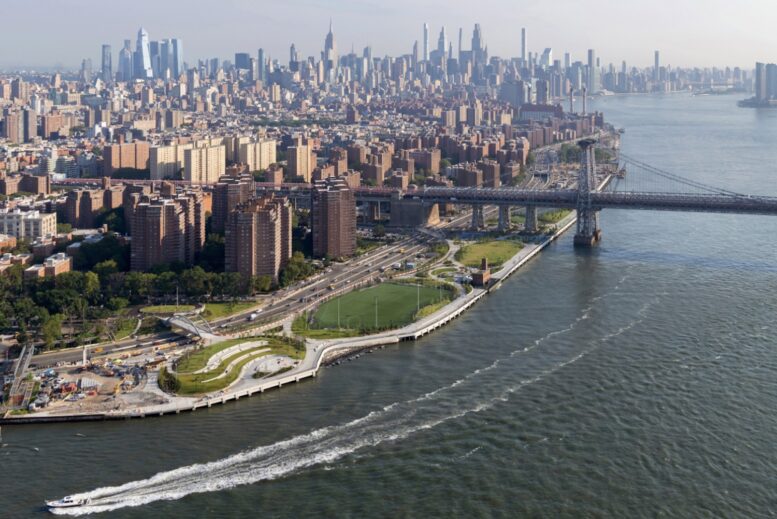
The first phase of the East Side Coastal Resiliency Project has officially opened at East River Park on Manhattan’s Lower East Side. The project features a series of interconnected, elevated parks spanning 2.25 miles along the East River waterfront that function as both public recreation areas and flood protection infrastructure. Led by the NYC Department of Design and Construction, the $1.45 billion initiative was designed by BIG–Bjarke Ingels Group in collaboration with Mathews Nielsen Landscape Architects, ONE Architecture & Urbanism, AKRF, and local residents.
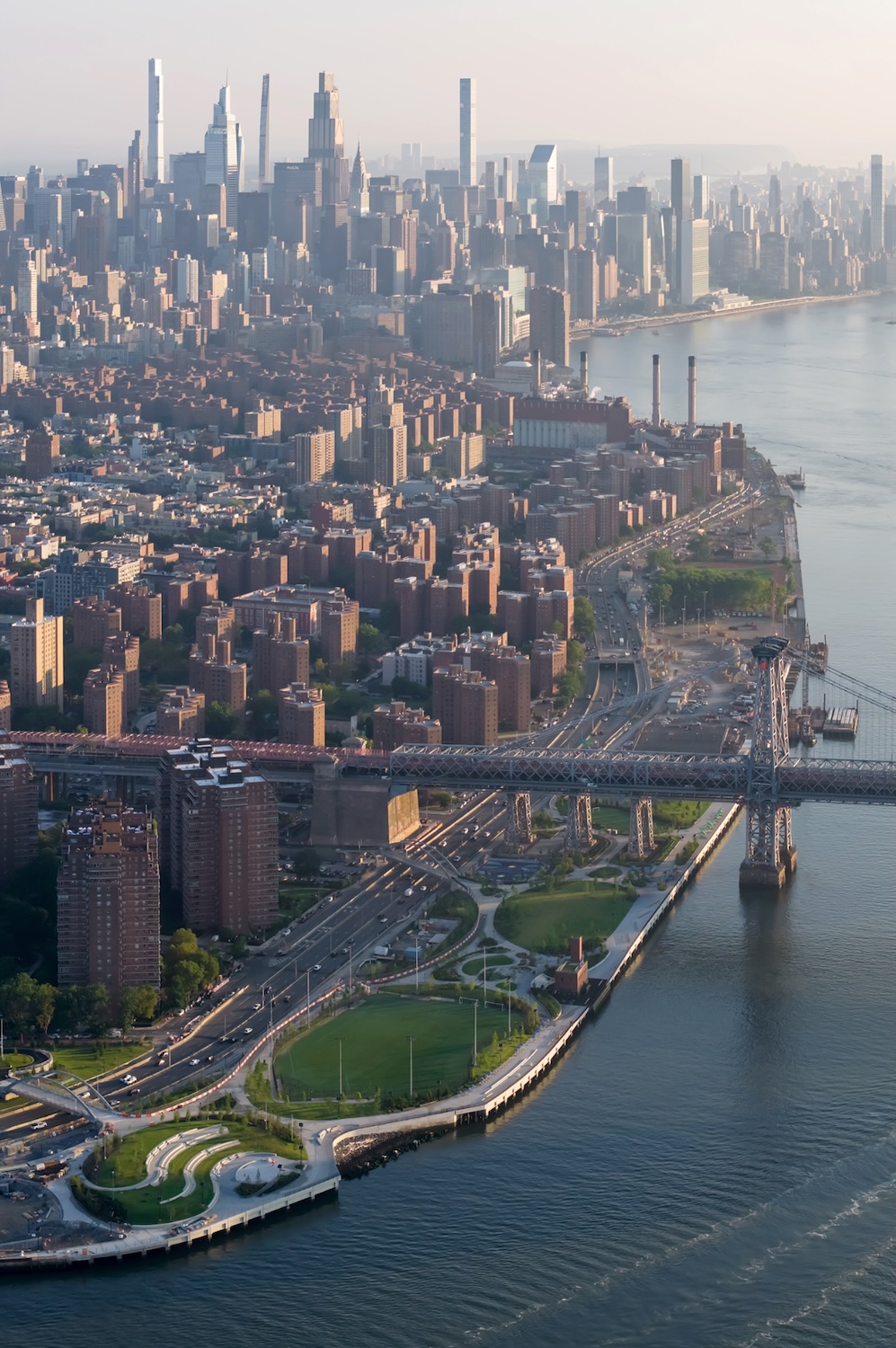
Photograph of East River Park. Credit: Iwan Baan.
Conceived in the aftermath of Superstorm Sandy as part of the broader “BIG U” coastal protection plan, ESCR stretches from Montgomery Street to East 25th Street. The design incorporates a range of flood mitigation strategies, including floodwalls, sliding gates, berms, and raised parkland, intended to protect more than 110,000 residents and critical infrastructure in the FEMA 100-year floodplain. Newly opened areas around the Williamsburg Bridge feature upgraded amenities such as basketball and tennis courts, barbecue and picnic zones, a turf field, lawns, an amphitheater, and zones for nature exploration and water play.
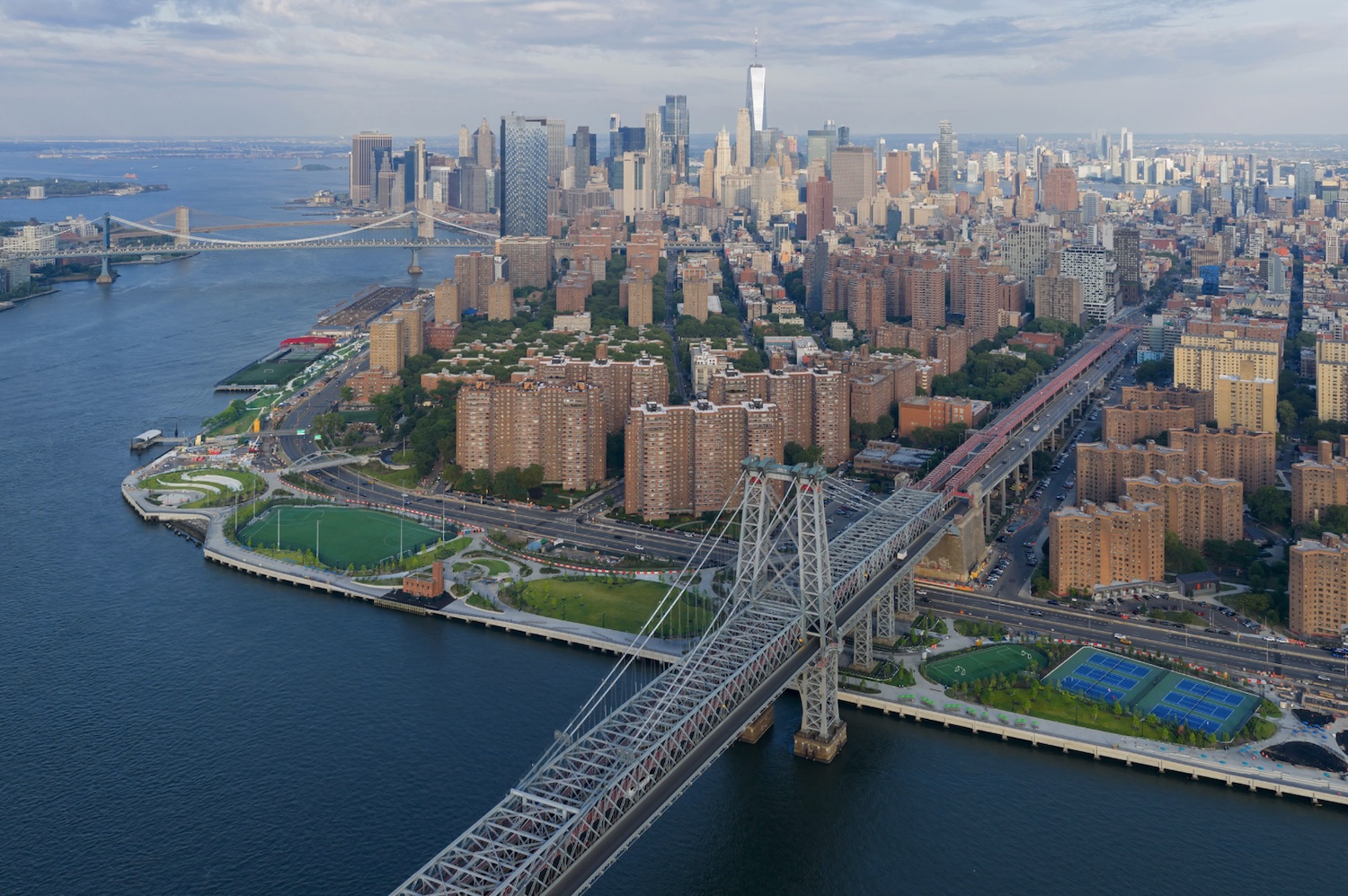
Photograph of East River Park. Credit: Iwan Baan.
Among the project’s major additions is the Solar One Environmental Education Center in Stuyvesant Cove Park. Designed by BIG with the NYC Economic Development Corporation and partners, the 6,409-square-foot facility features elevated classrooms, a 21kW solar array, battery storage, and flood-resilient design measures. The building will support environmental education programs and serve as a resource hub during emergencies, while forming part of a larger network of flood-resilient waterfront infrastructure extending to Battery Park City.
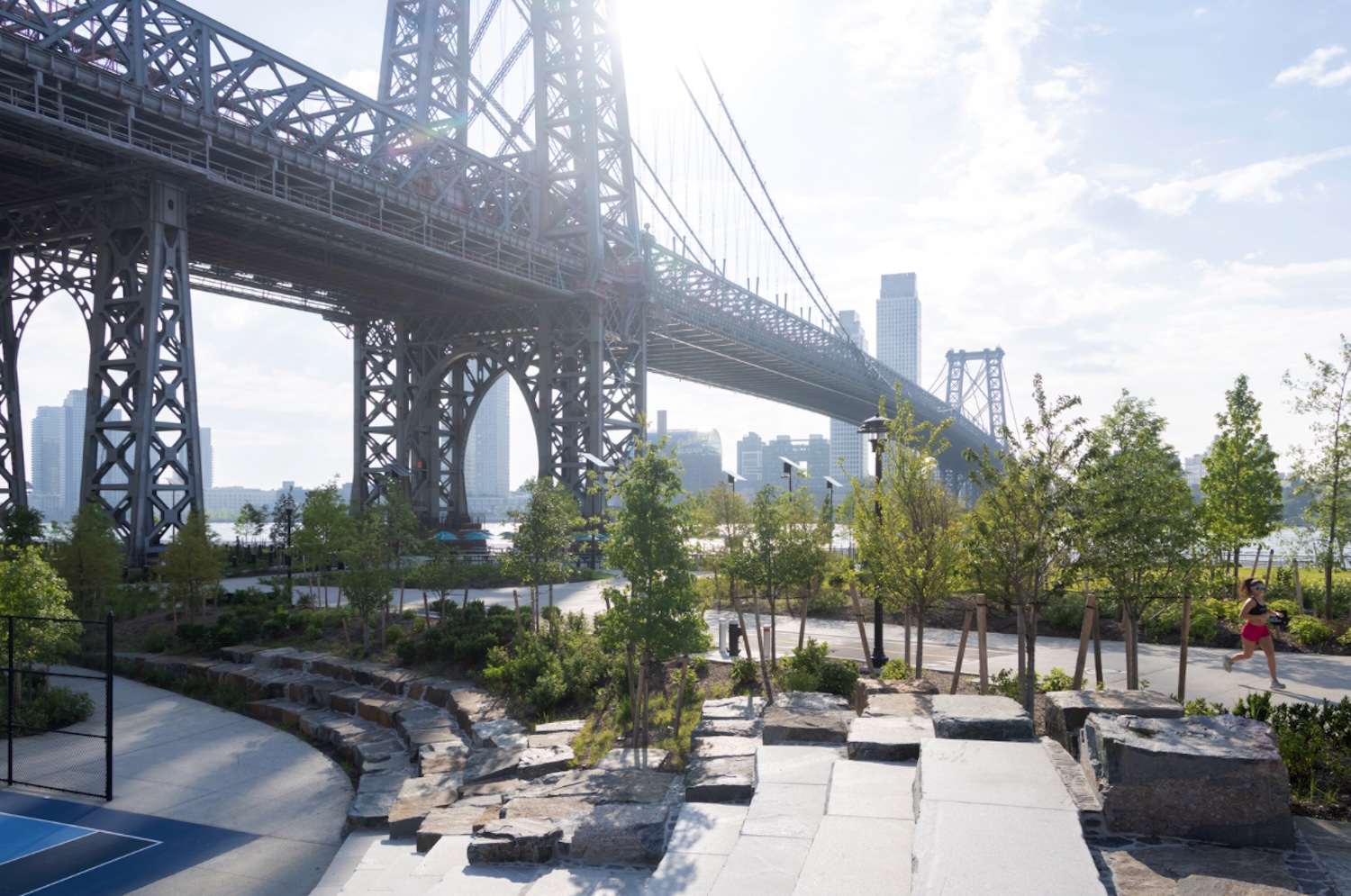
Photograph of East River Park. Credit: Iwan Baan.
“Rather than separating the city from the waterfront, we’ve designed a public realm that invites people in with new connections across the FDR, transforming flood protection into a tapestry of everyday experiences,” said Bjarke Ingels, founder and creative director at BIG. “The result is infrastructure that not only strengthens, but also enhances the city’s coastline.”
Subscribe to YIMBY’s daily e-mail

Follow YIMBYgram for real-time photo updates
Like YIMBY on Facebook
Follow YIMBY’s Twitter for the latest in YIMBYnews


The Park, and access to it are MUCH improved. Unfortunately, the loss of 1000+ trees will take a generation to recover (Summer shade will be hard to come by). This is a long-overdue amenity to the East Side, after decades of watching the growth of Hudson River Park — I look fwd to playing on the new tennis courts, next Spring / Summer.
The trees the trees the trees was always the big complaint but frankly its a microscopic price to pay for this. Someday they will grow back
For generations, ERP always provided shady relief from Summer swelter. To dismiss this loss as miniscule just casually dismisses a HUGE benefit provided by the park to the elderly, small children and just those wanting to enjoy the shade. I don’t disagree with the need for the park’s reconstruction, but I do acknowledge that a significant benefit of the park has been lost for at least a generation.
It’s passed time that NYC creates a tree farm for future use where mature trees can be provided for immediate use. Maybe a future Rockefeller Center Xmas tree?
What we need in NYC are winter hardy mangrove trees. Many buildings in my part of Flushing are 10-15 feet above sea level and Flushing Creek is not far away.
Who is responsible when this has no effect on flooding when the next storm arrives?
This whole coastal resiliency effort is akin to the moses era philosophy of having to destroy something in order to save it.