
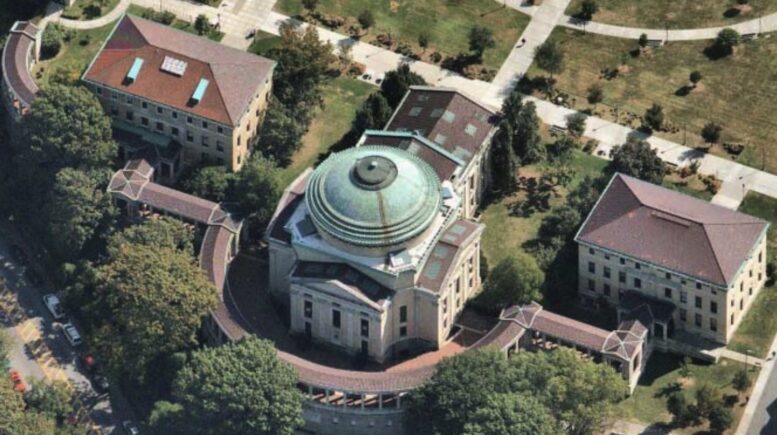
The New York City Landmarks Preservation Commission (LPC) is reviewing a proposal for restoration work on the Hall of Fame for Great Americans, located at 2060 Sedgwick Avenue on the Bronx Community College campus in University Heights, The Bronx. Originally constructed in 1901 by the architectural firm McKim, Mead & White, the structure is an Individual Landmark and a notable example of early 20th-century academic architecture. The restoration project is led by architect Michael Stripunsky, along with Bernard Toni and Amanda Loy, and is part of a broader initiative by the City University of New York (CUNY) to address structural issues affecting the building.
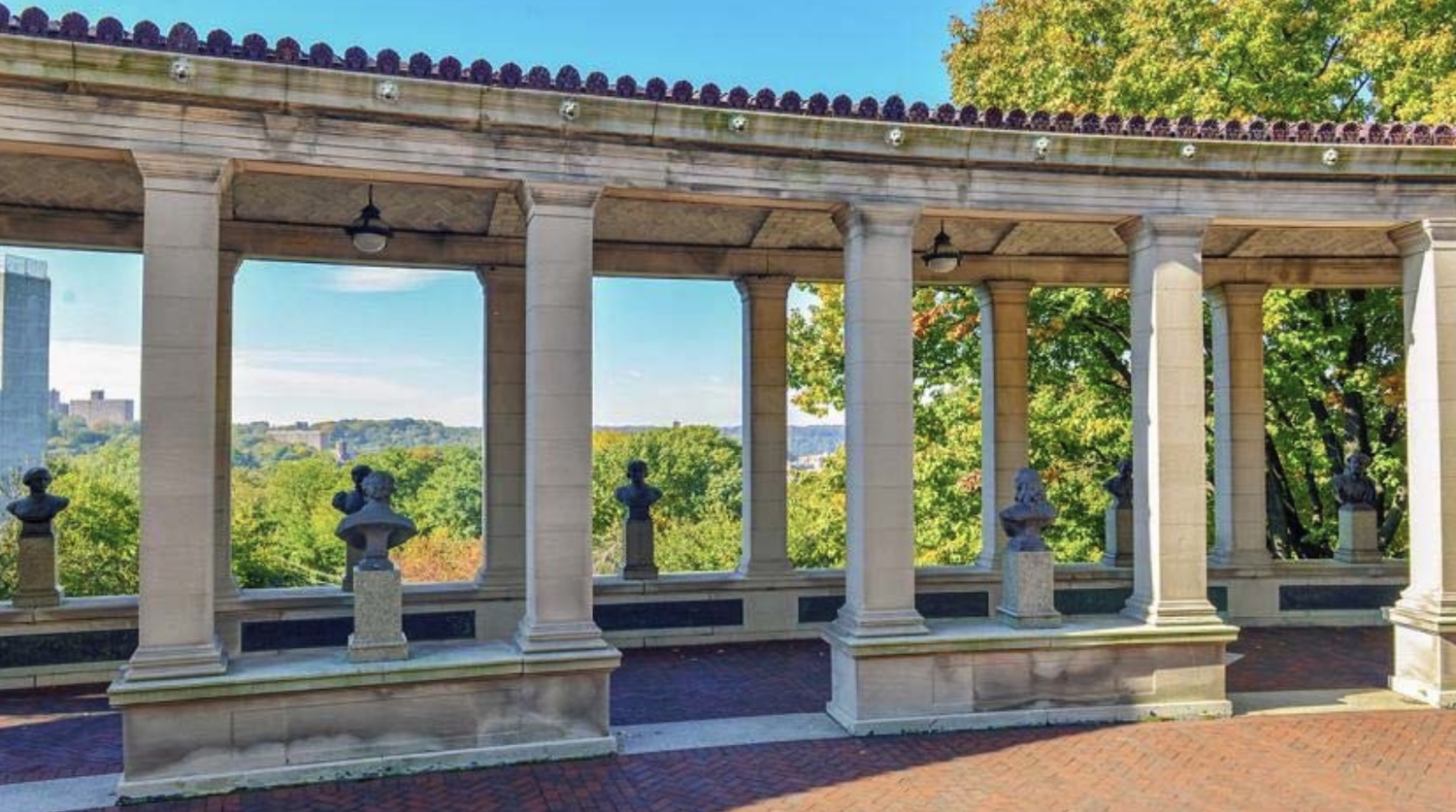
Photograph of previous conditions, via LPC proposal.
The Hall of Fame, built as an open-air colonnade to connect adjacent academic buildings, features limestone and terra cottamaterials, including Guastavino tile vaults. The structure houses nearly 100 bronze busts commemorating influential American figures. Over the years, deterioration of the limestone cornices has become severe and systemic across over 1,000 linear feet of the façade. The current condition includes cracking and spalling in multiple cornice stones, caused in part by the installation of wedge-type anchors during earlier repair campaigns. Due to safety concerns, protective netting has been installed, and the area remains closed to the public.
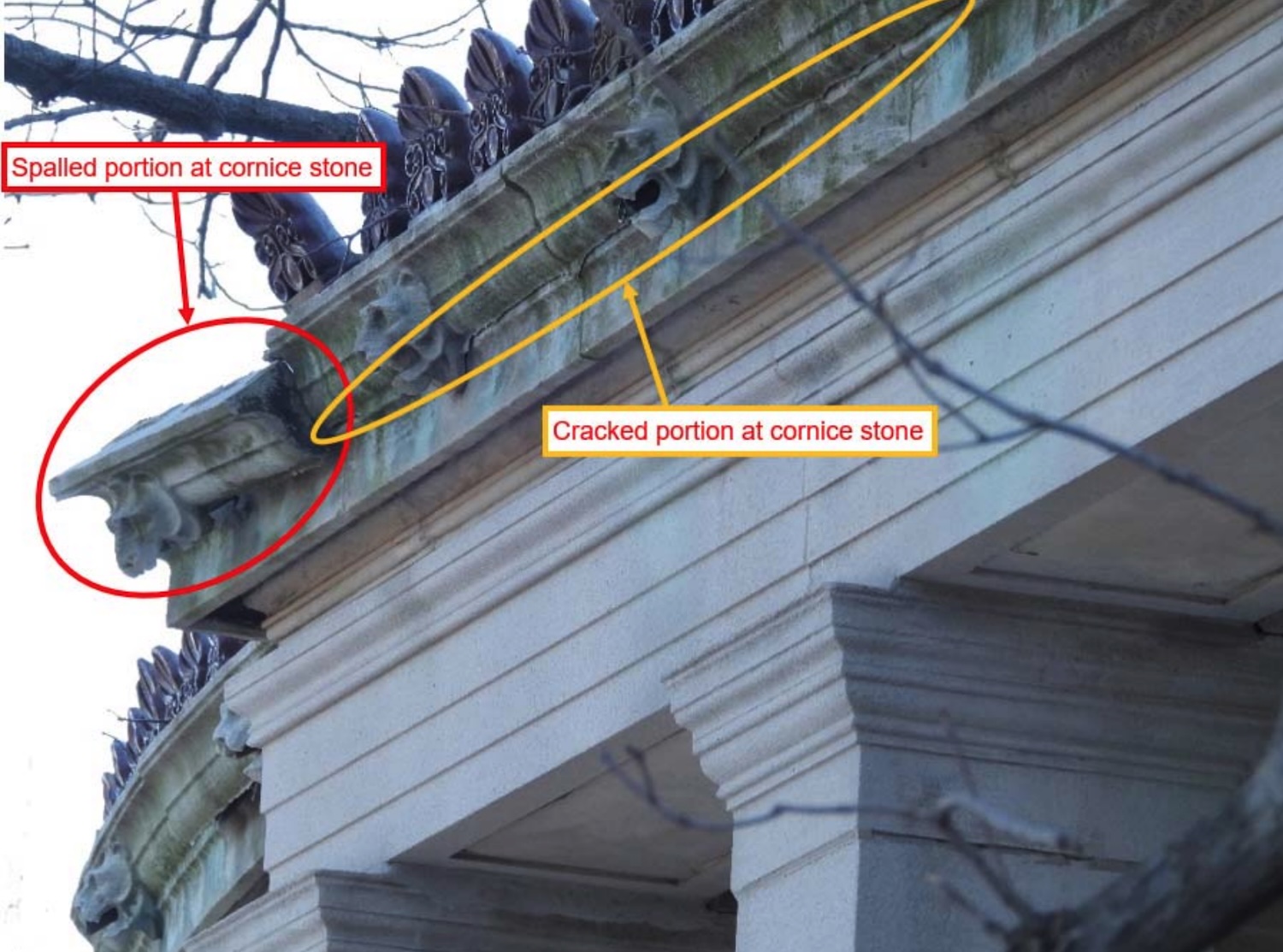
Photograph of current conditions, via LPC proposal.
The design team evaluated various restoration methods and determined that complete replacement of the cornices would compromise the structural integrity of the Guastavino vaults and require extensive demolition. Instead, the team proposes repairing the damaged cornices using Glass Fiber Reinforced Concrete units. This method allows for in-field adaptability, minimizes the need for original material removal, and has been successfully implemented in other landmark projects such as the Plaza Hotel and CUNY’s Thomas Hunter Hall.
Transit nearby the Hall of Fame site includes the 4 train at the 183rd Street station, as well as the B and D trains at the 182–183 Streets station.
Subscribe to YIMBY’s daily e-mail

Follow YIMBYgram for real-time photo updates
Like YIMBY on Facebook
Follow YIMBY’s Twitter for the latest in YIMBYnews

I lived at 1871 Sedgwick Ave. in the 1970s. For a time, one could enter the campus and enjoy the view. By then, the Hall of Fame had become moribund and no new statues had been added for some time. Due to rising crime, the campus was then closed to non students and my visits ceased. NYU then sold the campus and this had a profound effect on the surround neighborhood. Many headed off to the new Co-op City. I went off to Flushing in 1976.
I am pleased to see some effort to preserve this remarkable structure built on the steep side of a hill. The domed library is unused. It has a long stairway up to the glorious rotunda. Under this was a chapel which was gutted by an arson fire in the 1970s. This space was then rebuilt in an unsympathetic manner. A beautiful new library by RAMSA was built and all the books relocated. I hope some use can be found for the old library.
It is a tragedy that the city allowed it to happen. NYU should have been preserved there. There are also lots of beautiful houses near the campus that were used by the school and students – especially on University Ave. Tragic
In Dec. 1976, six months after I had moved out, there was a news segment on the decaying Bronx which showed the intersection of University and Burnside with all the buildings being abandoned. This was where I had done my food shopping, etc. The building where I lived survived, but many in the area did not. A large number of these were restored under Koch.
NYU wanted to move to its new campus downtown. I don’t see how they could’ve been “preserved” there. The city should’ve maintained the grounds but as we know they didn’t care too much about the Bronx for a long time.
NYU was having financial problems at that time and had to sell the Bronx campus to make ends meet.
They already had a campus downtown. They had no engineering school after they sold this campus. Not until years later did they buy Polytechnic in Brooklyn did they have an engineering school again.
I’m glad to see that something good is finally happening here. As noted in the article and the comment above, this has been a very troubled site for a very long time. If there was someway to make a major tourist attraction out of this, that would be even better.
Had it remained NYU’s engineering school the west side of the Bronx would be a very different place. And of course the actual property would not have suffered. So many things went wrong in that abandonment
Support for projects like this is always a precursor to the forces of ‘gentrification’ finding new territory.