
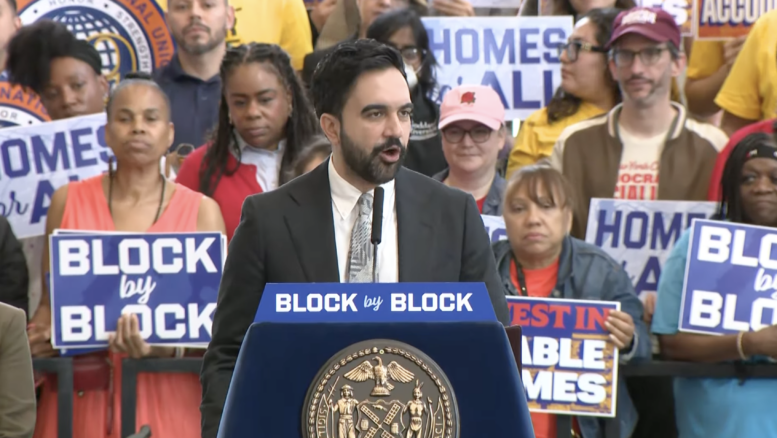
New York City Mayor Zohran Mamdani on Thursday highlighted key elements of “Block by Block,” the administration’s housing strategy aimed at addressing the city’s affordability crisis through the creation and preservation of affordable housing. The plan sets a goal of producing 200,000 new affordable homes over the next decade and is paired with nearly $5 billion in funding over the next two years for new rent-stabilized affordable housing, including dedicated investments in senior and supportive housing.
The initiative is being advanced by City Hall in coordination with the Department of Housing Preservation and Development, the Department of City Planning, and the New York City Housing Development Corporation.
Block by Block combines direct public investment, financing reforms, and a broad land-use agenda intended to increase housing production across the five boroughs. Key components include a citywide transit-oriented development proposal, the use of voter-approved land-use tools to accelerate affordable housing projects, and the creation of New York City’s first revolving loan fund for affordable housing development. The administration is also continuing implementation of Executive Orders 4 and 5, which were signed on Mayor Mamdani’s first day in office to speed housing development and expand affordable housing opportunities on city-owned land.
The plan incorporates recommendations from the Streamlining Procedures to Expedite Equitable Development (SPEED) Task Force, including reforms to environmental review procedures that city officials say will reduce development timelines for affordable housing projects. Additional strategies focus on maximizing the use of city-owned sites for both 100 percent affordable and mixed-income housing, including projects co-located with public facilities such as schools and libraries. The administration has also outlined efforts to preserve existing affordable housing and improve conditions in public housing developments.
“New Yorkers deserve a housing plan that meets this crisis with ambition, scale and urgency it demands,” Mayor Mamdani said. “If we want New York City to remain a place where working people can afford to live and build a future, we have to build far more housing and give New Yorkers housing options of all types, across the entire city. Block by Block is an all-of-the-above strategy to deliver the homes New Yorkers need, including 200,000 new affordable homes over the next decade.”
Subscribe to YIMBY’s daily e-mail

Follow YIMBYgram for real-time photo updates
Like YIMBY on Facebook
Follow YIMBY’s Twitter for the latest in YIMBYnews
What New York needs is at-cost housing, not “affordable” housing that will need to be subsidized by other tenants in the building or the government. So far, rent restrictions have withstood legal challenges, but that may not be the case forever.
I completely agree that we need to build as much housing as possible. All new supply helps ease the broader vacancy crisis and puts downward pressure on the market. However, framing at-cost and affordable housing as an either/or proposition misses the structural reality of building in New York.
Even if a developer builds completely at-cost with zero profit markup, the baseline costs of land, labor, materials, and compliance in NYC are so high that the final price tag is still entirely out of reach for low and middle-income New Yorkers. The private market simply cannot build cheap enough to house a working-class family without some form of intervention. Saying we shouldn’t use public capital or zoning relief to bridge that gap is essentially saying we shouldn’t build for those income tiers at all.
We don’t have to choose between market-rate supply and subsidized affordable housing. A growing and healthy city requires both working in tandem.
At whose expense should this subsidies derive? That’s the problem with the current affordability strategies. You are robbing Peter to pay Paul. Low-income apartments are subsidized by the adjacent market rate apartments. What you are left with are subsidized apartments which are still unaffordable to low-income residents, and market rate apartments which are now unaffordable to the middle class.
I’m not opposed to public investment in housing, but it needs to be at the capital level and not the operational level. Create a public REIT that derives capital from annual subsidy and the operating profits of its holdings. Use this funding to finance development of existing Xity-owned properties. The key is for the City to finance, not actually develop and manage these buildings themselves. Set parameters for unit count and operating profit of each holding. Without the land and financing costs, these buildings will be able to significantly undercut private competition and will drive down rents.
The success of such a strategy hinges on such a public REIT to be insulated by politics and made quasi-independent. If politicians are able to play games with the assets and developments, then the scheme falls apart. For example, such political games might include leveraging asset holdings to fill budget gaps, dictating development paremeters (e.g. union payoffs), and being unrealistic on contracted building operating practices.
Your proposal for a quasi-independent public REIT focused on capital-level financing rather than operations is a compelling structural approach. By using public funds to eliminate land and financing costs on city-owned properties, we can drastically lower the baseline cost of construction.
But even if a public REIT eliminates land and debt costs, the hard numbers of building in NYC like materials, safety compliance, and labor are still so high that the resulting “unsubsidized” rent would still be completely unaffordable for low-income and working-class families.
To bridge that final gap, we still need operational or direct capital subsidies for the lowest income tiers. We shouldn’t look at public capital as “robbing Peter to pay Paul.” When the city builds market-rate, middle-income, and low-income housing simultaneously, it expands the total supply, relieves pressure across the entire ecosystem, and ensures that New Yorkers at every income level have a place to live.
Housing affordability is a problem all around the world. Resistant suburbs need to be forced to densify, as is being done in California. I’m looking at you Long Island. The City is finally changing course and needs to keep pressing that momentum as its population reaches new highs. The new Mayor clearly understands this.
Yes, Davey, it’s Long Island’s fault that subsidized housing in NYC is a generational entitlement and a financial disaster (I’m specifically referring to NYCHA).
Your idealogy is like a parasite…invade and destroy.
During WWII, there was virtually no housing constructed. After this, the Federal Government took action on the serious housing shortage. The co-op where I live was built in the 1950s, along with many others in the city and country. These were participants in Section 213 of the National Housing Act. This provided for a mortgage insurance pool, paid for by the co-ops. This encouraged private funding for construction. This was entirely done without a cent of government money. The default rate was one of the lowest of any FHA program.
Section 213 is a brilliant piece of history. The core philosophy of it which is government-backed, low-risk financing for non-profit and limited-equity housing, is an essential tool that we should bring back. But unfortunately we can’t just copy-paste it to solve today’s housing crisis.
A lot about how we build has changed since the 1950s. Back then, we had massive tracts of cheap, undeveloped land in the outer boroughs and building costs were relatively low. Today the city is built out, land values are astronomical, there are tons more regulations, and supply chains and labor costs have escalated far past the rate of standard inflation. That makes it so that even zero-profit buildings are unaffordable to someone at NYC’s median income of $79K.
While government-backed financing is a fantastic tool that we should absolutely bring back to help the middle class, today’s shortage is a decades-deep deficit. To move the needle now, we need to pair that financing with massive zoning reform and we’d still need direct public subsidies to offset the staggering cost of modern construction.
NYC needs beautification first and foremost. More greenery and real parks.
Affordability is a losing battle in NYC, and any politician that tells you otherwise is lying to you for their own political gain. Move elsewhere in the country for affordability. The city where $1 million is a joke budget to buy, $4,000 is a joke budget to rent, and the most taxes out of pretty much all of the country is not a place you want to be on a budget.
America doesn’t have a housing crisis. New York doesn’t have a housing crisis. We have 100 million people here who should not be here. We have an immigration crisis. It amazes me how all the “moar housing!” zealots never, ever, address the real supply problem: the supply of excess people.
In that case, give me ONE example of an immigrant that stole affordable housing from an US veteran…
Yeah, I didn’t think so, you MAGA fuckface. And to call yourself a sensible man is shear hypocrisy.
It’s “more,” not “moar,” you moronic Neanderthal. I’d rather have a hard working immigrant than some lazy welfare cunt like you licking the boot of that orange pedophile that can’t die soon enough.
Poor people don’t need to live in Manhattan. Simple enough