
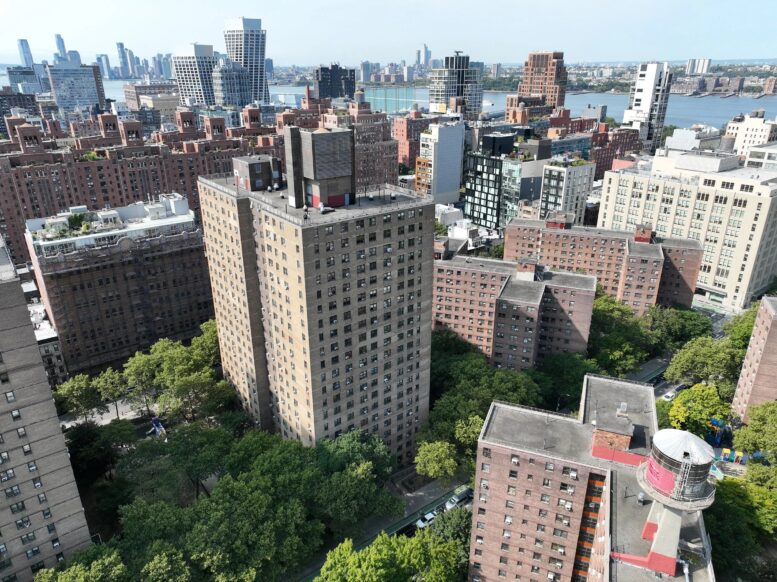
The U.S. Department of Housing and Urban Development (HUD) has approved the redevelopment of Fulton and Elliott-Chelsea Houses, a two-campus public housing assemblage in Chelsea, Manhattan. Designed by PAU, COOKFOX Architects, and Ismael Leyva Architects and developed by Essence Development and Related Companies under the Elliott Fulton LLC, the project will yield up to 5,510 apartments, of which up to 3,094 will be reserved for permanently affordable housing. The plan also includes new healthcare facilities, community centers, grocery and retail stores, and outdoor recreational space. The campuses are located between West 16th and West 19th Streets and between West 25th and West 27th Streets, respectively, each spanning from Ninth to Tenth Avenue.
Under the plan, all 2,056 existing apartments will be replaced one-for-one in brand-new NYCHA buildings, with only 6 percent of residents required to move temporarily during construction. An additional 3,454 mixed-income apartments will follow, 1,038 of them reserved at affordable rates. The rebuilt units will feature resident-controlled heating and cooling, dishwashers, and in-unit washers and dryers, and each campus will gain a new grocery store. Once fully complete, the project will address over $900 million in mounting physical needs.
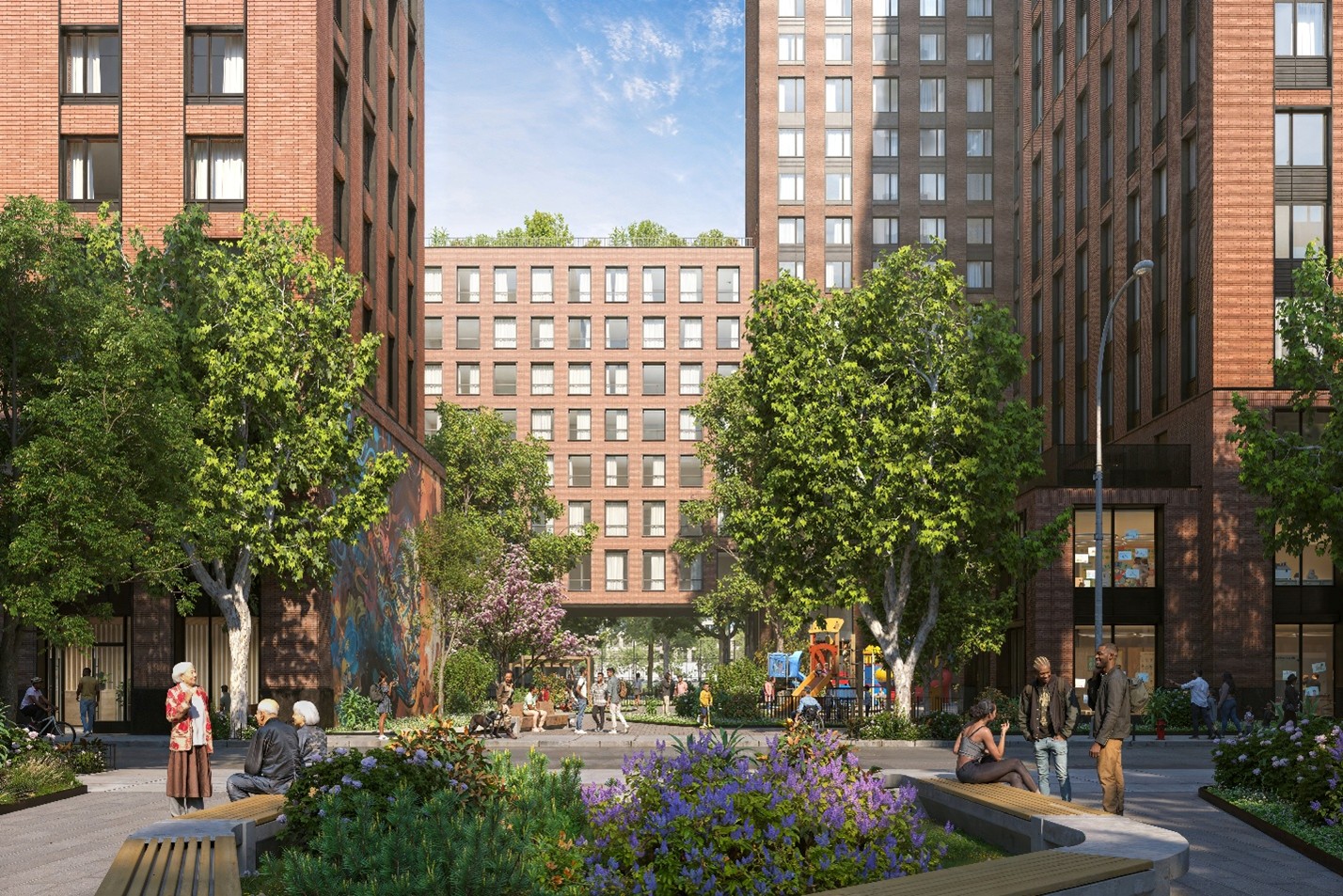
Rendering of Fulton And Elliott-Chelsea Houses, via nyc.gov.
The master plan, first announced in June 2023, replaces the campuses’ towers-in-the-park design with a perimeter-block massing that reengages the surrounding street grid. At Fulton, a linear park will span the blocks between West 16th and West 19th Streets. Construction will proceed in two phases, allowing the vast majority of residents to remain in their existing apartments until their replacement homes are finished.
Fulton Houses yields 944 units in buildings designed by Brown & Guenther and completed in 1965. To the north, Elliott-Chelsea Houses comprises 1,111 units, including the 1947 Elliott Houses by William Lescaze and the 1964 Chelsea Houses by Paul L. Wood. More than 4,500 residents live across the two campuses. NYCHA’s board approved the redevelopment in November 2024, and the projected cost has since risen to roughly $2 billion.
Phase one construction is expected to span approximately three years, with full build-out of both campuses targeted within eight years, according to project documents.
Subscribe to YIMBY’s daily e-mail

Follow YIMBYgram for real-time photo updates
Like YIMBY on Facebook
Follow YIMBY’s Twitter for the latest in YIMBYnews

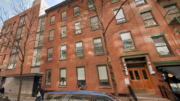
Hoping for improvement, these existing NYCHA buildings are an antithesis to the charm of Chelsea..
Absolutely transformational. A positive change for NYCHA residents, the surrounding area and visitors. So glad to see this moving forward.
Hopefully the same happens at other NYCHA complexes, particularly those of lower density, in prime areas where the costs make sense. Thinking Vladeck, Queensbridge, Marcy, etc.
The greenest buildings are the ones already built. Renovating the original buildings while adding new infill structures would have been the better choice. Probably the cost wouldn’t have been much different, so adding to a landfill was predictably chosen.
The city determined the cost to rehabilitate wasn’t worth it compared to the alternative of a tear down and rebuild. These will be brand new buildings with far more units and completely modern standards. Better site layout, passive house, fully electric, mixed income, mixed use.
This is going to provide a far higher quality of life and overall positive impact compared to the rehabilitations going on at other complexes.
Looks like these buildings are being torn down because they were grossing out people who live by the high line.
HUD could have easily just sent funding to repair the buildings in the first place.
Definitely not easy and as discussed there are many more benefits that come along with the rebuild.
NYCHA’s original replacement estimate did not include the necessary costs of existing-building demolition and new-building design. Only after shepherding the plan through Master Development Agreement hearings did NYCHA admit that it had left these costs out, as it explained how its new-construction estimate had ballooned by nearly a billion dollars in a CB4 meeting on December 16, 2024. Current estimates put the costs of comprehensive rehabilitation at well under half the cost of demolition and reconstruction with the rehab estimate taking 3 years and the demolition and reconstruction taking over 20 years.
The City never conducted an independent rehabilitation cost analysis for Fulton or Elliott‑Chelsea. Instead, Related Companies asserted without evidence that rehabilitation would cost more than demolition. Later, Related admitted the opposite: demolition would cost more than rehabilitation. That contradiction alone shows that the redevelopment justification is not based on credible or verified data.
It is also misleading to claim that the redevelopment will produce “better site layout,” “Passive House buildings,” or “fully electric buildings.” None of that can be stated as fact unless the speaker has personally designed the project or reviewed the actual architectural plans. How do you know this or are you pushing a narrative?
Furthermore, Fulton and Elliott‑Chelsea are already mixed‑income communities. This proposal would restrict current residents to only three buildings, while the majority of the campus land would be transferred for the construction of new affordable and luxury housing. This is not “improvement” it is a reduction of public‑housing footprint and a transfer of public land for private development.
What is being endorsed here is not resident benefit it is a plan that shrinks public housing, displaces families, and hands over most of the land to private developers without the required City Council approval, City Planning review, or ULURP process.
It is a land grab.
The siting of the existing NYCHA buildings is terrible – there is all kinds of anti-urban parking lots, unused lawns, meandering pathways, and underused gathering spaces. This is the consequence of building on only 25% (or less) of the lot; it was common when planners and city leaders and architects worshiped Le Corbusier and his bogus “Radiant City” philosophy – am glad to see this place go!
Here here
Hear hear rather
Calling our lawns and courtyards unused space shows a fundamental misunderstanding of what makes a community healthy and livable. These open spaces are not empty; they are active social infrastructure. They are where elders sit and talk, where neighbors connect, where children climb, play, and explore, and where workers from the neighborhood take a moment to breathe, eat lunch, or decompress.
Open space is not a luxury. It is a public‑health necessity. It is how people in dense urban environments maintain mental health, reduce stress, and feel safe enough to gather. It is how communities stay connected. It is how children develop physically and socially. It is how residents reclaim a sense of dignity and belonging in a city that often tries to erase them.
When you dismiss these spaces as “unused,” what you’re really saying is that you don’t value the people who use them the seniors who sit outside for fresh air, the parents who need a safe place for their kids to play, the neighbors who talk across benches, the workers who rest during their break, and the residents who simply need a moment of quiet in their own neighborhood.
Open space is part of our right to breathe, our right to gather, and our right to exist in community. Shrinking it, privatizing it, or paving it over for luxury and “affordable” development is not progress; it is erasure. And it tells residents exactly where they stand in your priorities.
Hi Renee, I do not feel that we are talking about the same things here; what I was referring too “unused space”, a lot of it is lawns that are fenced in between pathways and buildings that literally nobody us allowed to use; this is typical of NYCHA buildings all over the city. Additionally, a fair number of dedicated recreation/play/resting areas are in fact used by NYCHA residents (rarely by outsiders through), the fact remains that many such areas are not used well at all. Nor are many of NYCHA complexed underendowed with paved areas; most of them seem to have too many walkways and parking lots necessary for their size. I feel confident that the majority of open space in NYCHA is in fact unused or greatly underutilized, and that this is due to fundamental design errors.
As a taxpayer in NYC, one of my priorities is housing for all New Yorkers, not merely a subset of them. By providing housing to nearly 3,000 more people than the current projects do, this redevelopment is certainly a step in the correct direction. There will be less open space in the redevelopment to be sure, but it is very likely to be more intensively used by all residents of Chelsea, not just those living in the projects.
This is a reply left by the user named Monath:
These buildings have been a critical part of Chelsea’s “charm” for decades. Saying that these campuses are an antithesis to your self described “charm” is classist and racist.
Fulton & Elliott-Chelsea Houses were here long before Hudson Yards. Not the other way around.
I love when YIMBY’s show their true colors. It has nothing to do with new housing. It is the fact that wealthier New Yorkers cannot stand the sight of public housing, and the diversity NYCHA represents.
Presumptuous, the apartments are being replaced on a one to one basis, ‘residents will be allowed to stay in their present apts until their replacement homes are finished”..and that’s great.
They keep saying, but there will be a loss of bedrooms in Fulton and Elliott Chelsea which is a way of erasing community
No way.
Smelly, dirty, run down, ghetto, shady.
Worst areas of Chelsea are right next to these projects.
If by “worst areas of Chelsea” you mean the High Line, the Avenue School, and the luxury buildings that sit partly vacant,
“ The greenest buildings are the ones already built.” are you insane? This is not factually correct. These buildings are energy monsters, poorly designed, and harm the urban environment
The buildings are not that old fireproof and construction. The spacing is nice with trees, grass and open areas. The Maintenance and upkeep were definitely lacking and subparr,
These buildings have never experienced significant renovation and decades of deferred maintenance. They are in very poor shape. Almost every system likely needs to be rehabilitated, electrical, plumbing, heating, roofs, facade, elevators, etc. Infestations, mold, asbestos, etc.
They want to give poor newyorkers condo like dwellings and beautify the area? Yeah ok..Just another way to use enimnant domain
I thought Related was involved in a Chelsea project. Is this the one and have they been dropped given their lack of popularity with the mayor?
The residents of these projects were given the voice, and the choice, of having the buildings renovated or replaced. They voted for new buildings.
There has never been a vote. There was a misleading 3-question survey that was never presented as a vote, and which never mentioned demolition. A little over 500 residents filled out that misleading survey – fewer than a quarter of the residents. The scope of the proposed demolition and reconstruction was never presented to the residents – the RFP for the project stipulated rehabilitation and expressly NOT demolition. The residents have never voted on the project directly; however, a substantial majority of the residents voted for the one and only District 3 City Council candidate who was expressly against demolition.
There was never a vote. NYCHA Presentation on Survey Results to the Chelsea Land Use Committee stated that it was a survey: 1. new construction with rezoning; 2. new construction with existing zoning; 3. rehabilitation of existing units. The word demolition was never used.
And all the asbestos and lead will be released for EVERY resident of Chelsea,to breathe in. The casualties will be astronomical. 😈
What a twisted, psychopathic, retarded sickfuck you sound like, Eliza.
You’re an evil human being Eliza. Wishing ill on innocent people and acting like the devil.
Get your facts right. HUD has issued no approval. PAU left the project citing the large number of residents opposed to it.
The project will waste a billion in public funding to permanently eliminate 250 public-housing bedrooms, not to mention cut down 370 mature trees.
As to some of the comments, the residents never voted for this plan and have even sued to stop it. They’ve overwhelmingly testified against it for three years. NYCHA has stated that the buildings are all structurally sound, meaning they can be reused—a far greener approach than needlessly replacing their foundations and structural skeletons, even if they were stripped down to raw concrete, which is far more than comprehensive modernization would require.
HUD approved. The NYCHA will own the land. The residents are guaranteed a new apartment, it’s law.
Structurally sound does not mean the buildings are not currently in poor condition. Over $1 billion to renovate. New construction comes in over $2 billion but more than doubles the housing, provides new buildings, mixed income, supermarket, community spaces, improved layout and designs…FAR BETTER!
We still do not know the actual cost of renovating Fulton and Elliott‑Chelsea. The City never conducted an independent rehabilitation analysis, and although Related Companies claims they did one, they have refused to show the documents after repeated requests from residents and Manhattan Community Board 4. That lack of transparency speaks for itself.
Related originally claimed that rehabilitation would cost more than demolition. Later, they admitted the opposite: demolition would cost more than renovation. When a developer contradicts its own justification, it becomes clear that the numbers are being used to push a predetermined outcome. That is why I feel you are not interested in facts or transparency; you are interested in advancing this proposed project, regardless of whether the underlying claims are accurate.
HUD has not approved demolition. What HUD did was simply renew the RAD Conversion Commitment because the 90‑day clock expired. Any statement implying HUD has approved demolition is misleading.
The article you’re referencing is also incorrect. It claims the PAU is still part of the process, but that language appears to come directly from a NYCHA press release, not from HUD or any independent source. It repeats NYCHA’s talking points without verifying them. No one should pretend this project is justified or inevitable.
The facts you use need to be accurate and complete. We do not know what the so‑called “affordable” rents will be. There is no finalized affordability schedule, no binding rent tables. Touting “affordable housing” without actual numbers is misleading at best.
We also do not know that there are “$900 million in physical needs.” That figure has not been independently verified, and residents have not been given access to the underlying assessments or documentation. Repeating a number without proof is not analysis; it’s marketing. From what has been shown of the design, this plan does not “re‑engage the street grid.” It encloses and cages the existing public‑housing community, restricting residents to a smaller footprint while opening the rest of the land to “new development.” This is containment, not connectivity. You also failed to mention Related’s brownfield application, which is another way to pull in additional public dollars for this project. Leaving that out hides a key part of the financial picture and the extent to which public resources are being leveraged for private gain.
If you’re going to speak on this, make sure the facts you’re stating are correct and make sure you’re telling the whole story, not just the parts that help push this project forward.
If the retail is street-facing, this project is good in my books. Le Corbusier ahh tower-in-the-park developments have no place in a city as dynamic and vibrant as New York.