

Work is moving along on the first phase of the redevelopment of the Port Authority Bus Terminal in Midtown, Manhattan. Designed by Lord Norman Foster of Foster + Partners and Epstein (A. Epstein and Sons International) as a joint venture for the Port Authority of New York and New Jersey (PANYNJ), the $10 billion project will replace the 74-year-old, 2.1-million-square-foot structure with a modern, higher capacity terminal to better serve its hundreds of thousands of daily commuters. The property spans two city blocks between Eighth and Ninth Avenues and West 40th and 42nd Streets.
Construction is currently taking place on the western side of the bus terminal and the land surrounding the entrance and exit lanes of the Lincoln Tunnel.
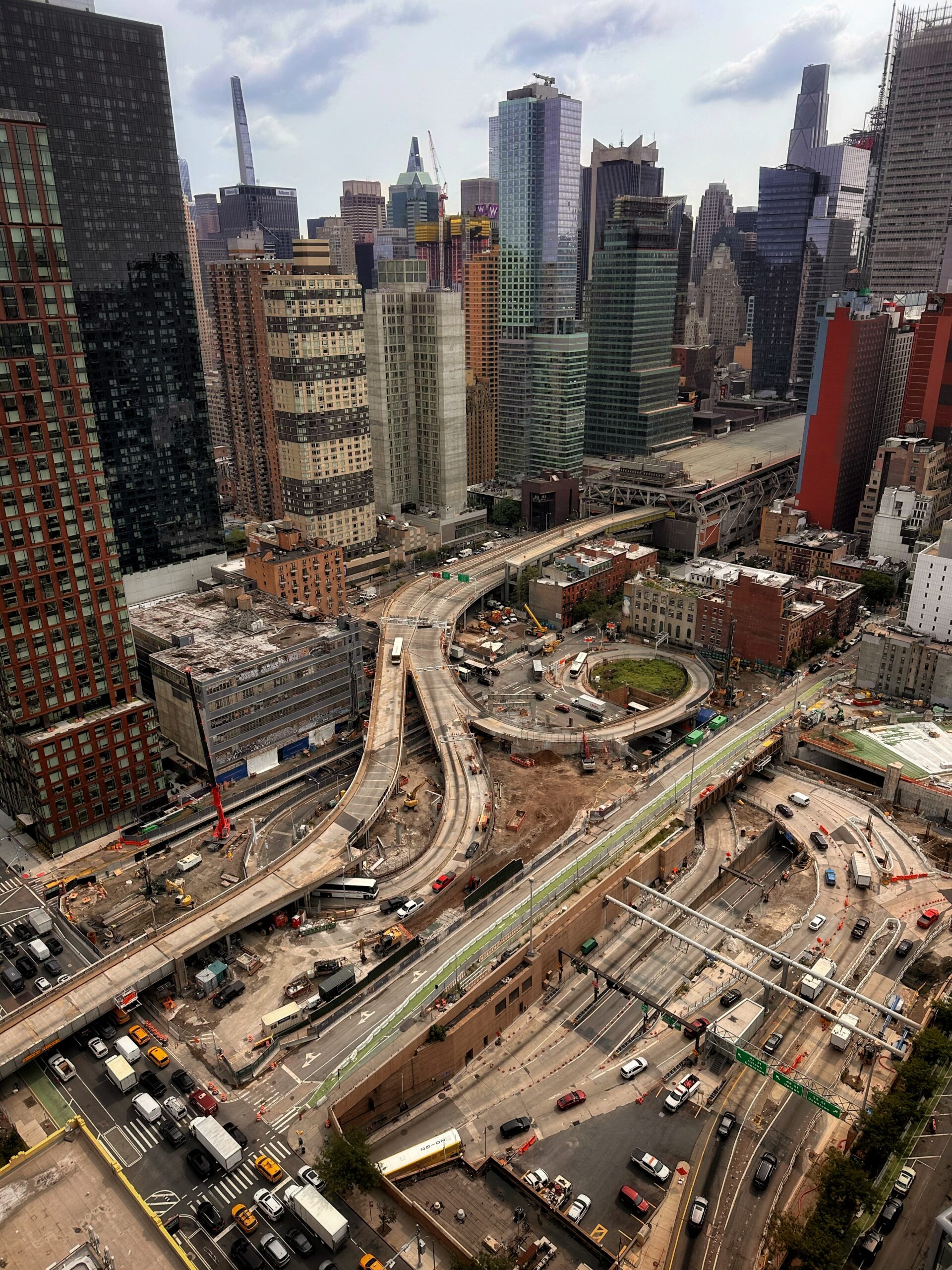
Port Authority Bus Terminal construction in August 2026. Photo by Michael Young.
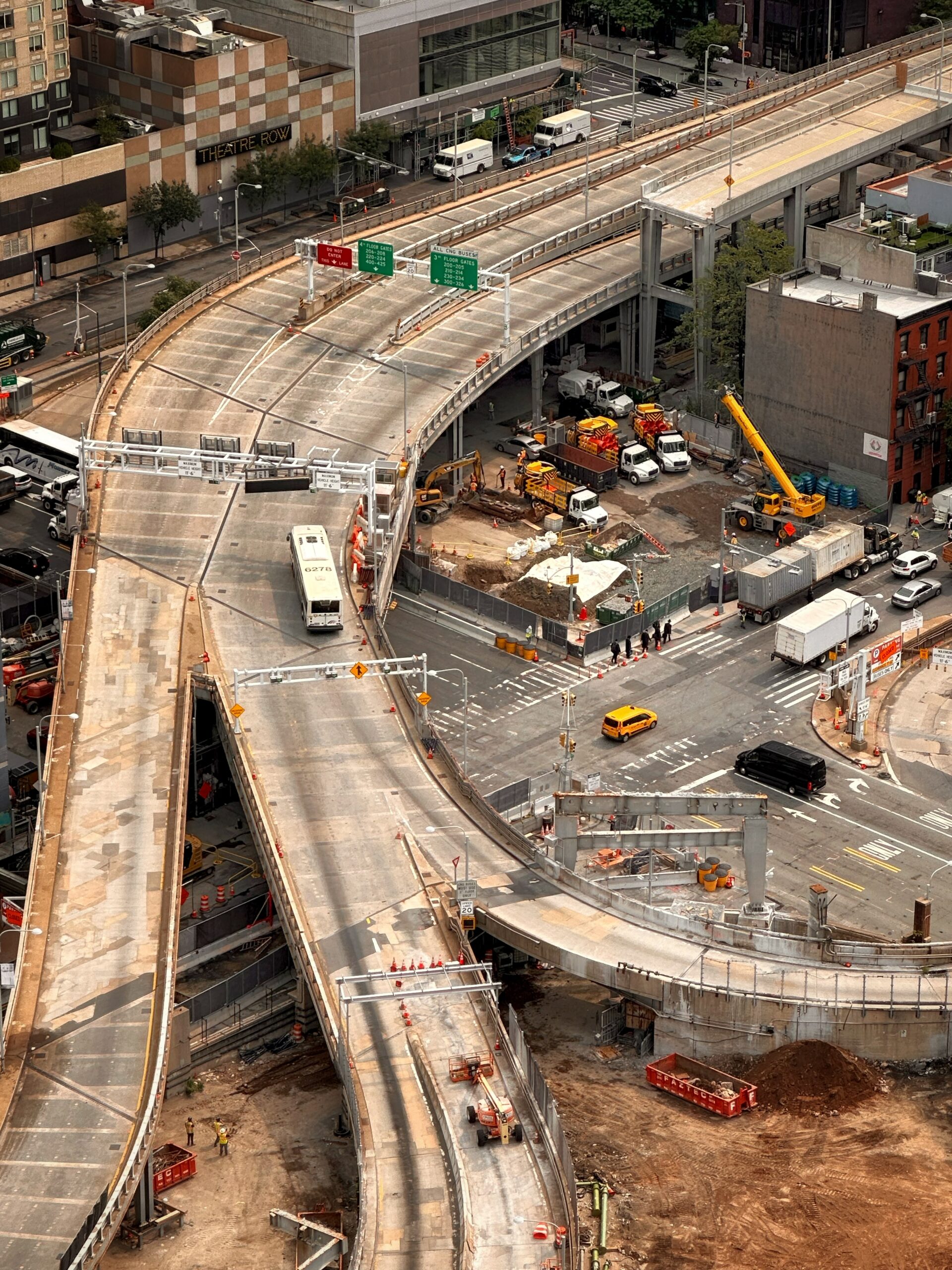
Two down ramps have been demolished, as indicated by the exposed patches of dirt between West 39th and 40th Streets. Excavators are currently clearing debris and tearing up the remaining steel columns that held up the roadway. Only one section of the uppermost concrete deck is left standing above the city block and Ninth Avenue between West 40th and West 41st Streets, directly behind a row of low-rise apartment buildings.
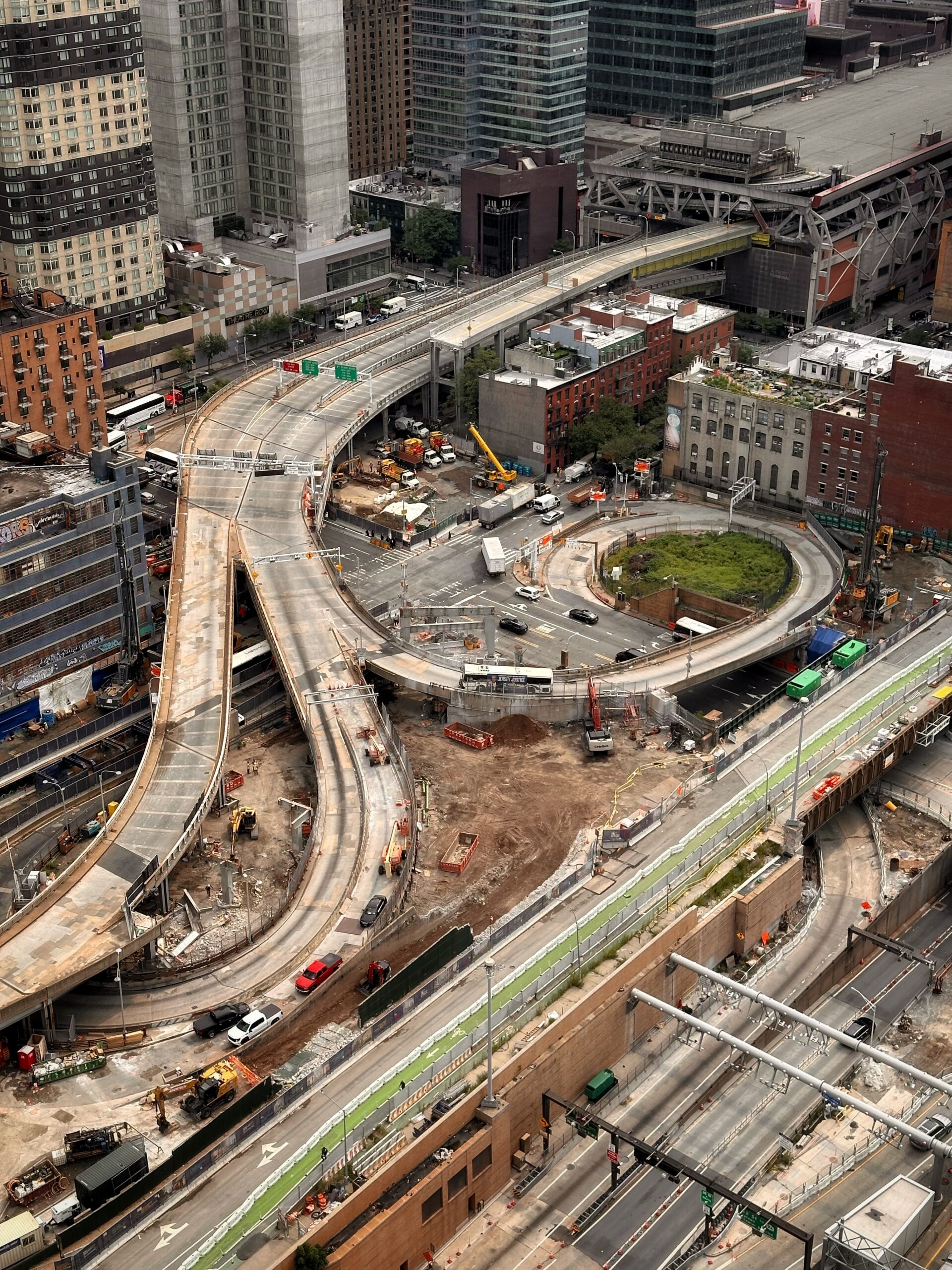
Port Authority Bus Terminal construction in August 2026. Photo by Michael Young.
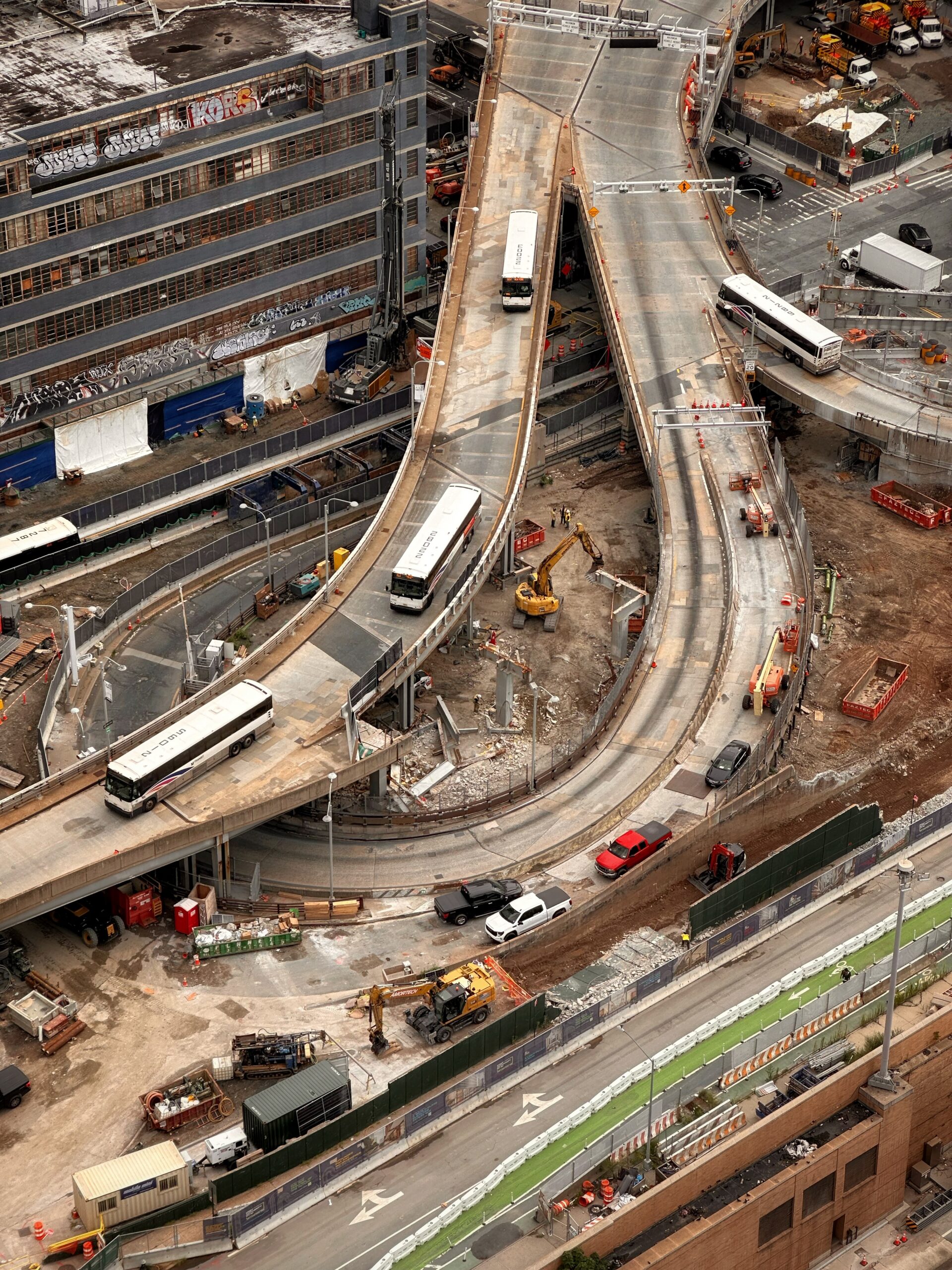
Access to the terminal via the spiral helix bounded Dyer Avenue, West 39th, and West 49th Street is now limited to one roadway. The piling machine on the right side of the below image is where the second off-ramp to West 39th Street was formerly located.
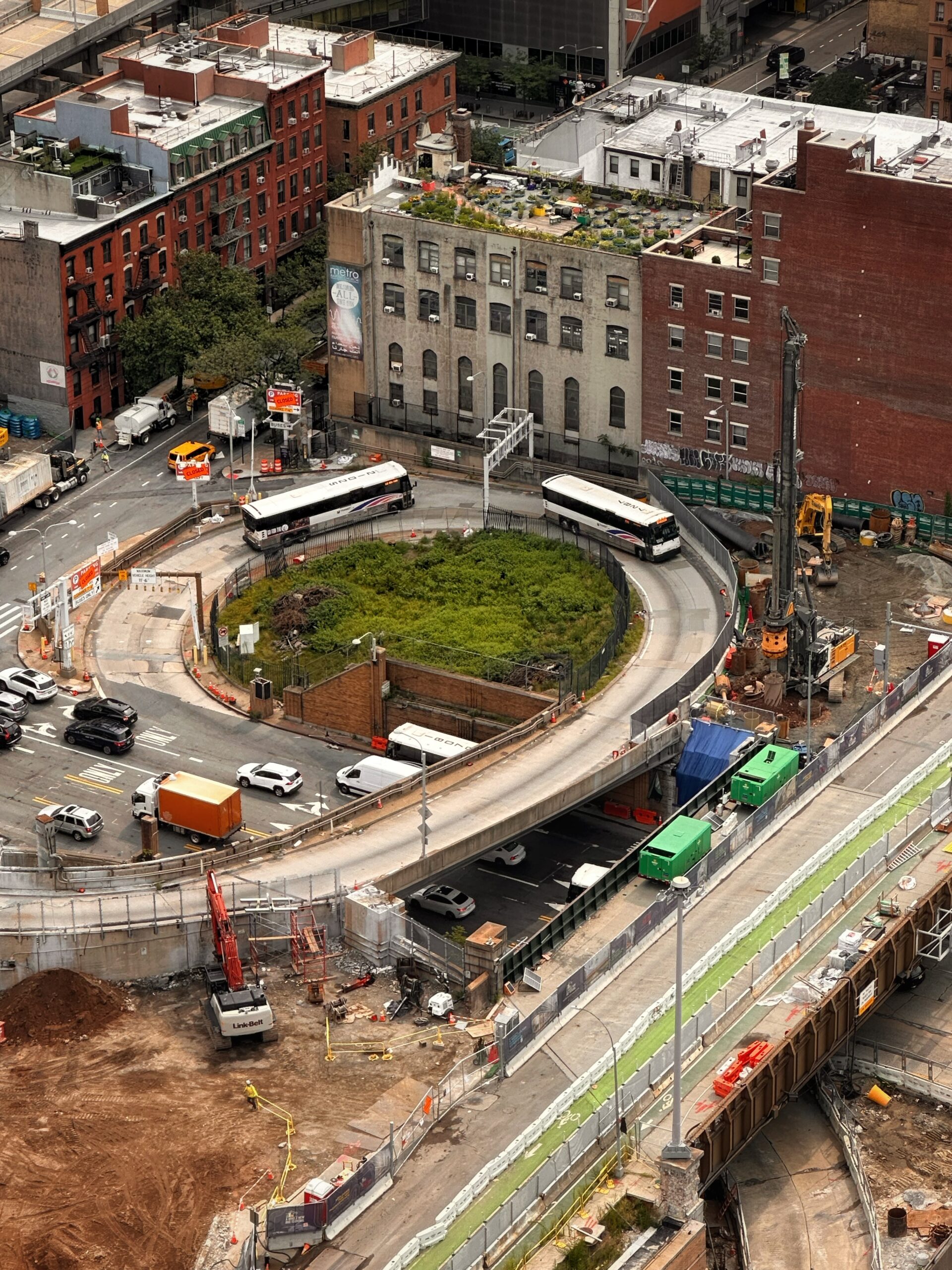
Port Authority Bus Terminal construction in August 2026. Photo by Michael Young.
The open-air parking spaces on the roof remain closed to the public.
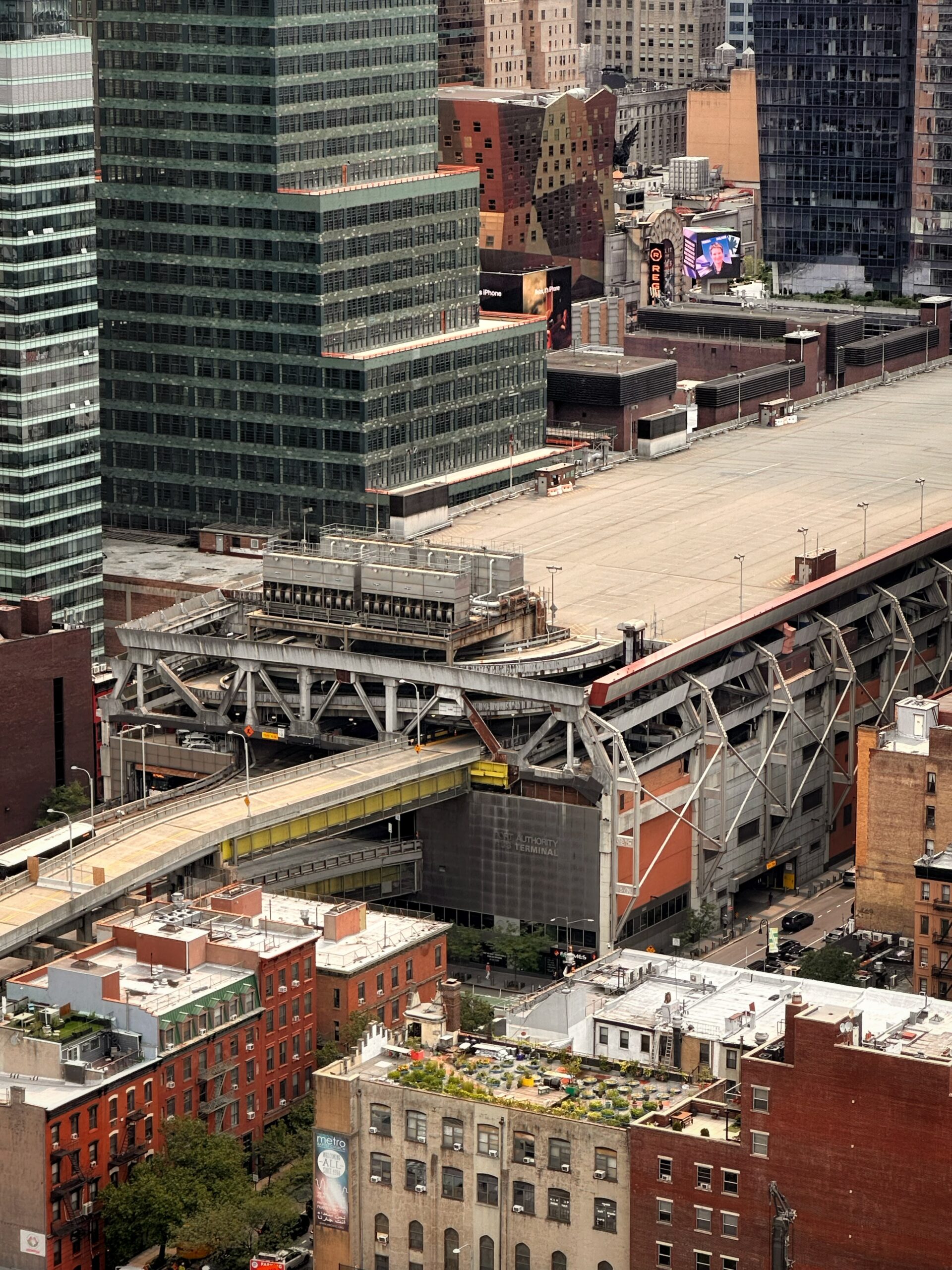
Port Authority Bus Terminal construction in August 2026. Photo by Michael Young.
The existing set of elevated roadways further west are still in operation.
Port Authority Bus Terminal construction in August 2026. Photo by Michael Young.
Below are two images showing the western half of the city block along Tenth Avenue between West 39th and West 40th Streets. Two entrance lanes formerly served traffic turning west onto West 40th Street from Dyer Avenue, and are now reduced to just one. A third entry point located along Tenth Avenue was also closed off.
Port Authority Bus Terminal construction in August 2026. Photo by Michael Young.
The former street-level approach has also been demolished and is currently occupied by heavy machinery.
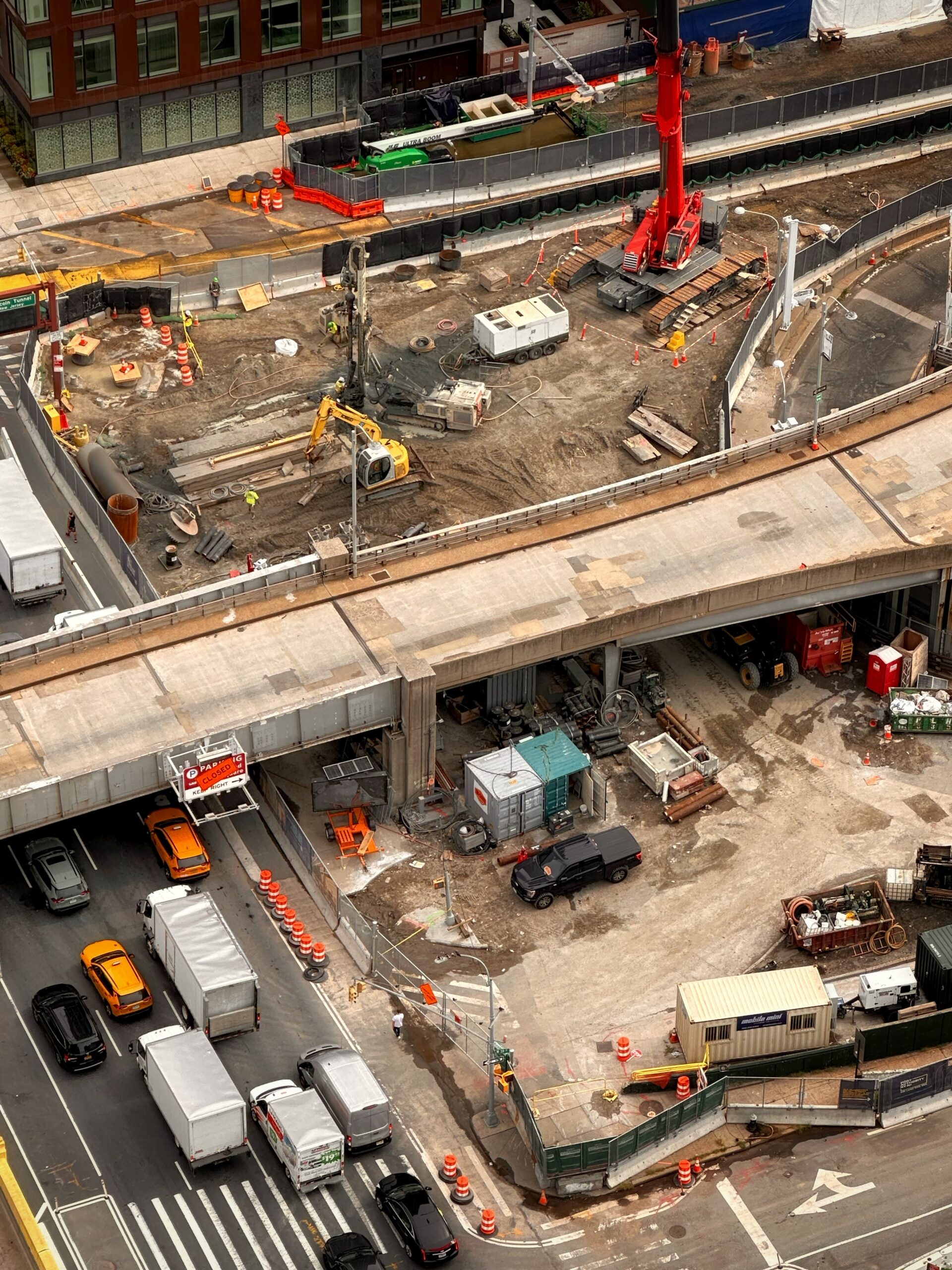
Port Authority Bus Terminal construction in August 2026. Photo by Michael Young.
The single elevated exit ramp over Tenth Avenue continues to serve buses.
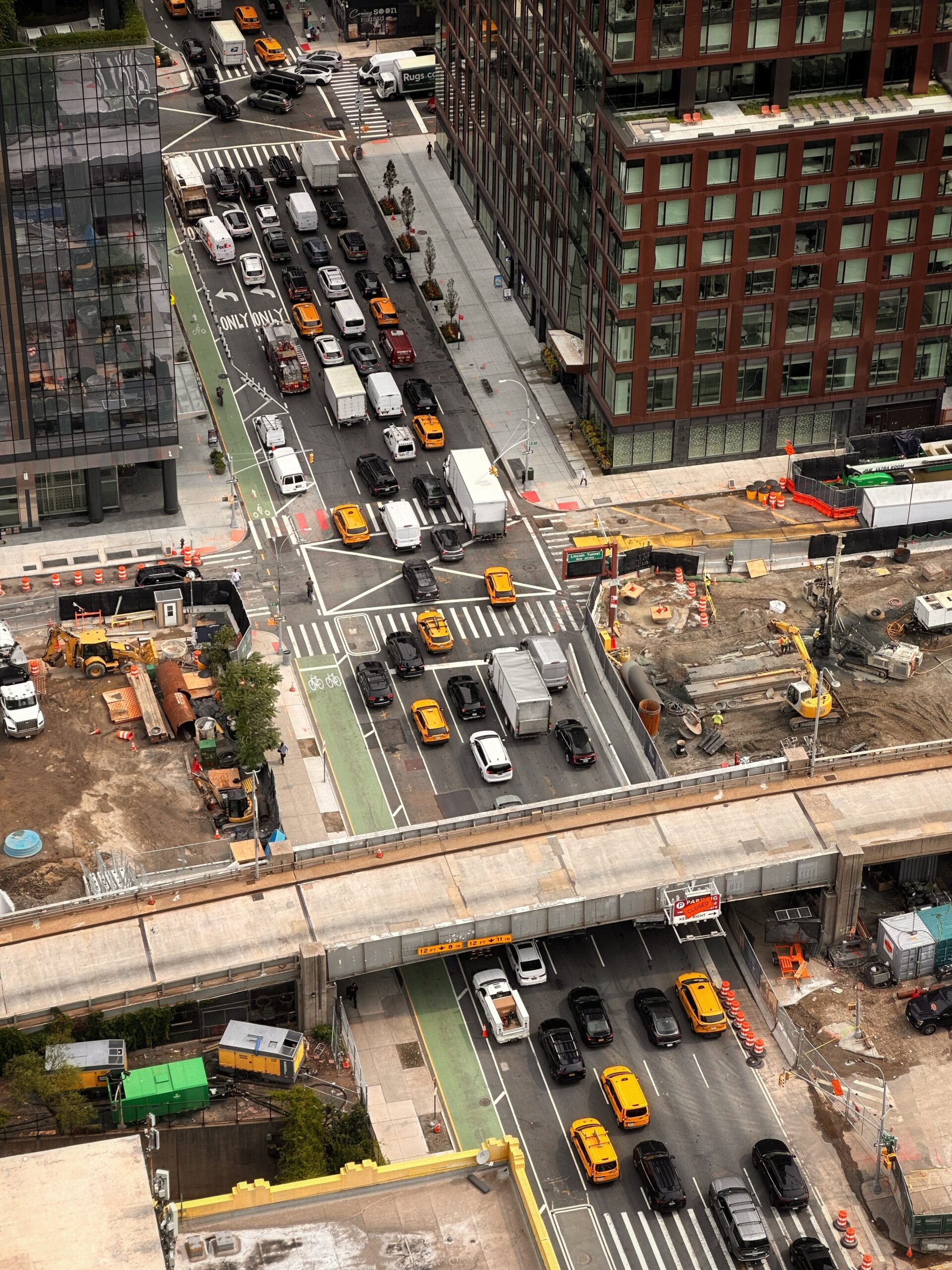
Port Authority Bus Terminal construction in August 2026. Photo by Michael Young.
The former bus parking lot along West 40th Street is currently being used as a staging area. A small community park formerly occupied the sliver at the southern side of the exit ramp but is now also being used for temporary equipment storage.
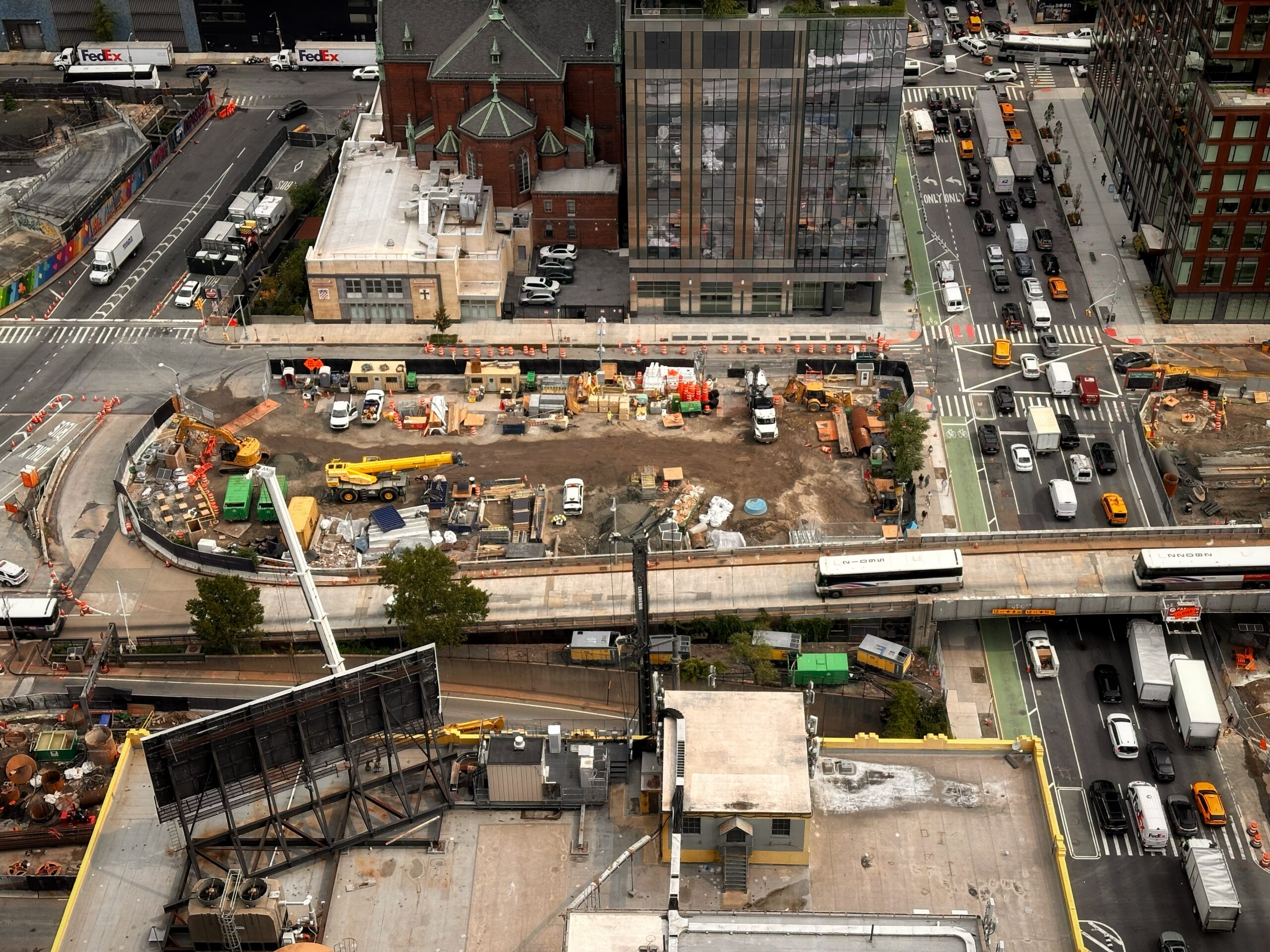
Port Authority Bus Terminal construction in August 2026. Photo by Michael Young.
Meanwhile, significant progress has unfolded on the new Dyer Avenue deck-over between West 38th and West 39th Streets, which will eventually become a 3.5-acre public park. The first sections of steel rebar are visible around the exit lanes from the Lincoln Tunnel, while barriers and fencing surround the current perimeter. Subsequent sections will extend the deck-over to its full scope, and this surface will temporarily serve as bus staging while the remainder of construction progresses on the terminal.
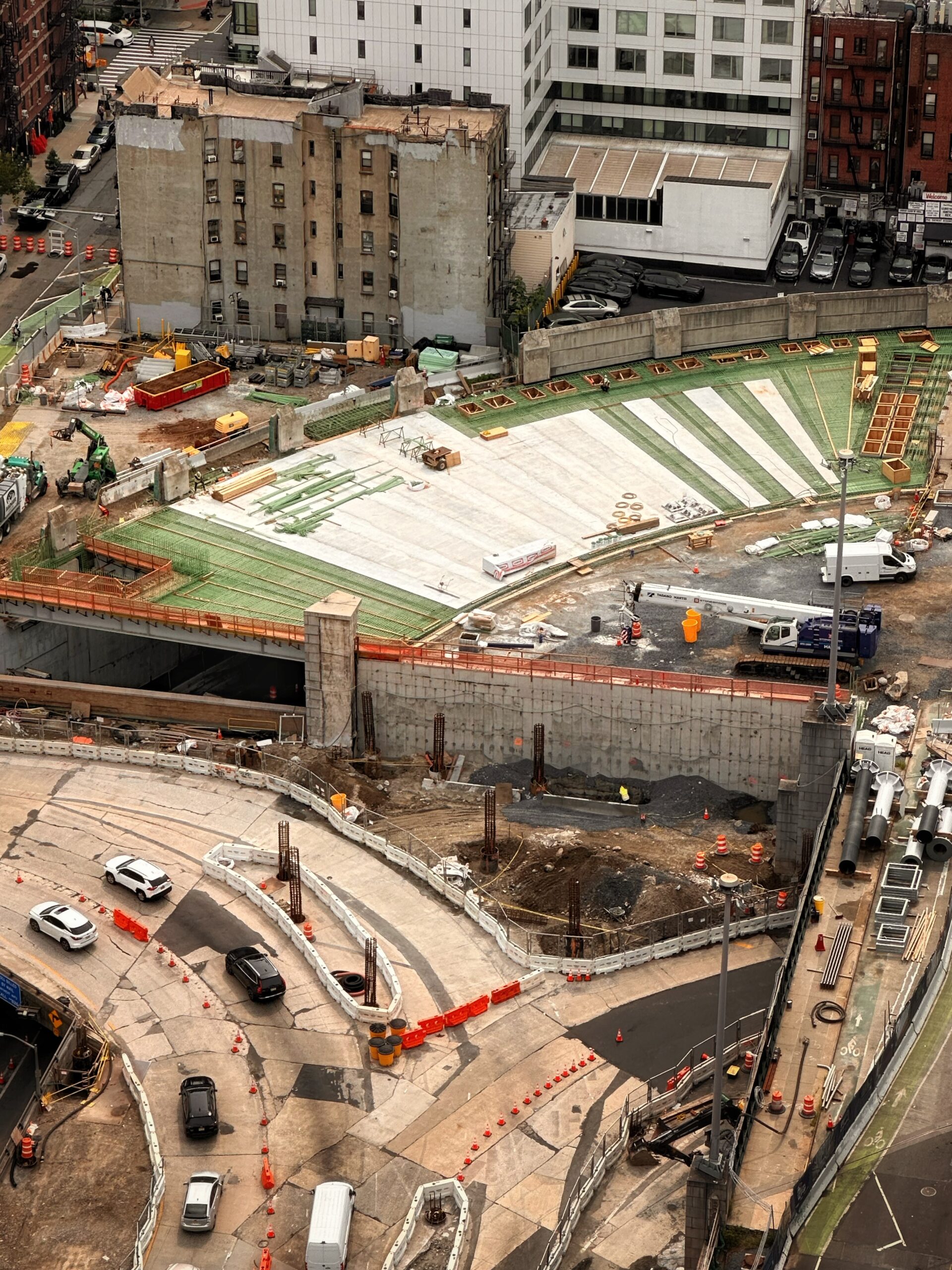
Port Authority Bus Terminal construction in August 2026. Photo by Michael Young.
The below rendering offers a street-level perspective of the southern face of the bus terminal from the green space that will be built on top of Dyer Avenue.
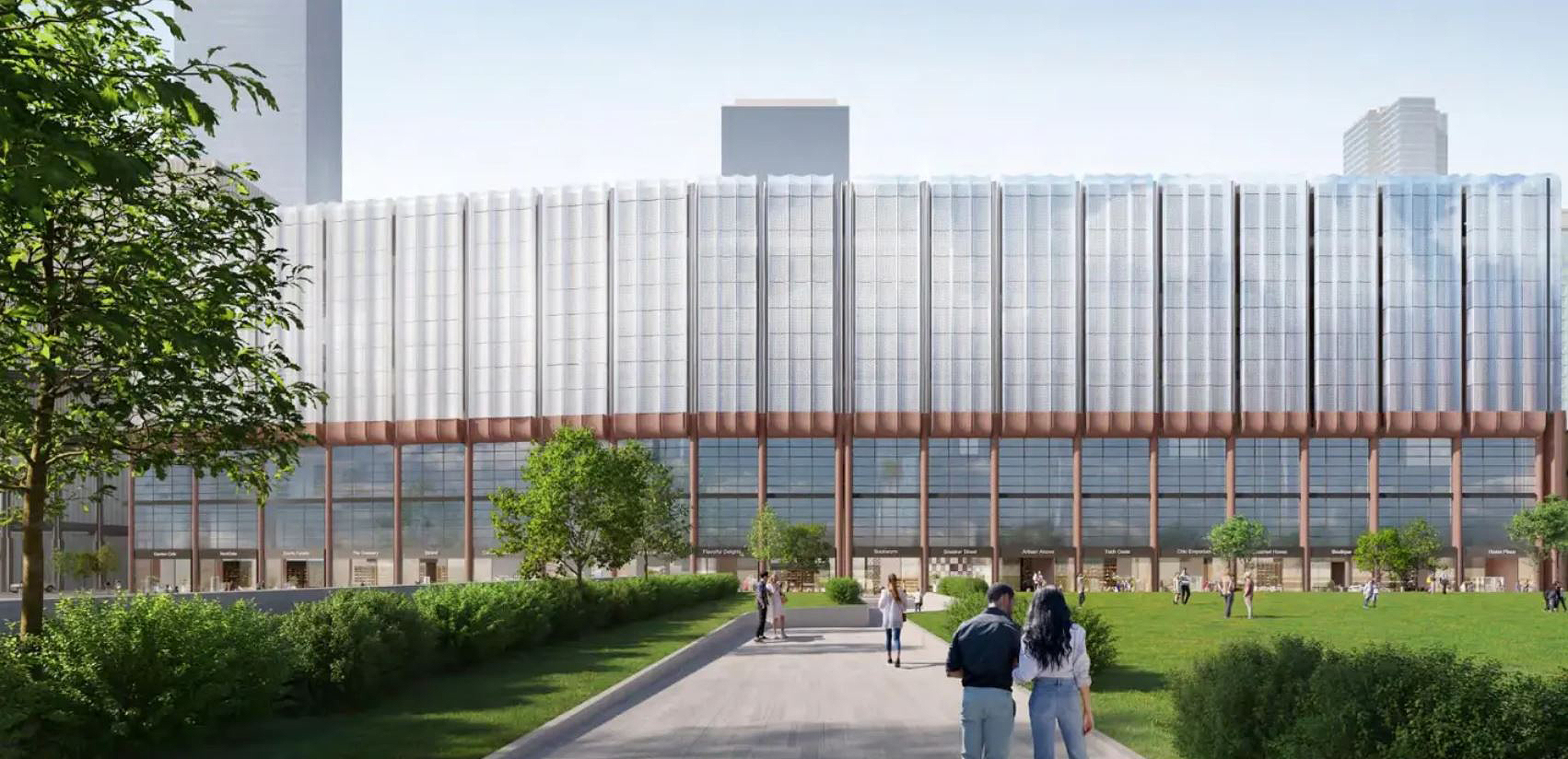
Rendering courtesy of the New York City Department of Planning
The first stage of construction, from 2024 to 2028, includes erecting new ramps, the Dyer Avenue deck-over, and an additional temporary storage and staging facility. Phase two will last from 2029 to 2032 and involve the construction of the new terminal, during which time the storage and staging facility will serve as the hub of operations. The final phase will commence afterward and add the public green space to the Dyer Avenue deck. Phase three is also planned to involve the construction of two office skyscrapers rising 926 and 1,346 feet high with a combined maximum floor area of 5 million square feet, or a Floor Area Ratio (FAR) of 18.
The project is expected to yield five floors for buses, including 40 gates for intercity buses, and will increase bus storage from the current 50 slots to between 300 and 350 spots for midday capacity. The new terminal will feature a central atrium with 155,344 square feet of retail space, more than doubling the current total of 69,365 square feet. The facility will also have taller ceiling heights and electric charging stations for buses.
More info can be seen in our previous coverage.
The new Port Authority Bus Terminal is expected to be completed around 2032.
Subscribe to YIMBY’s daily e-mail

Follow YIMBYgram for real-time photo updates
Like YIMBY on Facebook
Follow YIMBY’s Twitter for the latest in YIMBYnews

What a jigsaw puzzle!
I am not certain I will be around to see this finished, but it will be a major improvement to the city.
2040?…hopefully you’ll still be with us
I would be approaching the century mark.
On weekends I look after my friend’s mom, she turns 107 in November, it’s doable..
Makes my head hurt.It is amazing that operations will continue thru all this construction.
Spending $10 billion in taxpayer money on a new bus terminal is simply too much. Politicians seem to spend public money like drunk sailors without seriously considering whether there are smarter, more cost-effective alternatives.
Instead of spending billions on a massive terminal in Manhattan, New York and New Jersey should think regionally. The land could potentially be sold or developed through a public-private partnership, with a requirement that the private developer build a modern bus station as part of the project. This could reduce the burden on taxpayers while still providing the transportation infrastructure the city needs.
Even more importantly, we should stop bringing more buses and traffic into the heart of Manhattan. A better long-term solution would be to develop a major transportation hub in Newark, New Jersey, where buses could terminate and passengers could transfer to fast, frequent trains into Manhattan. This would reduce congestion, pollution, and the number of large buses traveling through the city.
New York and New Jersey should also create a direct, efficient transportation connection linking Newark, Meadowlands Station, Newark Airport, and Midtown Manhattan around 42nd Street. Imagine being able to travel from the airport or New Jersey to Midtown quickly without adding thousands of additional buses to already overcrowded streets.
The problem is that politicians often think in small pieces instead of thinking about the entire region. We need a bold, long-term transportation strategy that connects New York and New Jersey rather than treating them as separate systems. Instead of spending $10 billion simply rebuilding what we already have, let’s use this opportunity to create a transportation network that reduces traffic, lowers pollution, saves taxpayers money, and works for the next generation.
Some good ideas but you can’t put everyone on trains that are at capacity. Buses provide another way to get into the city; otherwise, all your eggs would be on the trains. Newark couldn’t handle the bus volume, and it would take me twice as long to get to Newark as to the PA terminal, and I still wouldn’t be in the city.
I do totally agree that we need to see things regionally. NJ Transit trains should go to Queens (some do, but they are empty!), and the LIRR and Metro-North trains can go to Secaucus and/or EWR. NJ Transit trains need a stop in Jersey City. Amtrak should stop at Secaucus. If a NJ-based Uber goes to NYC, they should be able to take someone back to NJ. All the systems should have ONE way to pay. We can do dozens of things to make the region more efficient.
Tony, I agree with you 100% !
There is kind of a public/private partnership here; the last part of the construction supposedly involves the private development of two very large office skyscrapers over the southwestern part of this terminal..the development rights funding etc will go to the Port Authority..
Port Authority municipal bond money isn’t taxpayer money. To build a new train line from the airport to the Meadowlands to Manhattan would require vastly more than $10 billion.
Do you think anyone in New Jersey wants to take a bus to the Meadowlands to then take a train to Manhattan?
Also a PPP is already what the PA has planned for the Midtown Bus Terminal redevelopment.
This isn’t taxpayer money. This is Port Authority’s money.
You don’t actually live here, do you? Great in theory, but near impossible to implement what you’re describing. Come to a local community board meeting to propose it.
The local community board has long been in favor of extending the #7 line to the Meadowlands, an idea Bloomberg pushed. Can you imagine if all the World Cup fans had been able to attend the matches on a $ 2.50 trip ?
There are a lot of good ideas here, but I think before we tackle a new terminal in NJ, maybe we start smaller. For example, I’ve always thought it could be useful to build an bi-directional Express Bus transfer station on the former Huge Carey Tunnel Toll Plaza. The location is a natural pinch point for Express bus routes with unused land, and creating a transfer point there would allow people riding express busses from various parts of SI, Brooklyn, or other parts of the region to switch to a different busses dropping of in a different area, i.e. downtown, uptown, FiDi, etc, or even to change directions so someone on a SI express Bus from Tottenville SI or somewhere else to Manhattan could switch to a different express express bus heading towards Far Rockaway or somewhere else.
It’s such an abstract at this point, what’s the point of showing anything?
Quite impressive.
After 74 long & gritty years, it’s surely time that we provided our hard-working next door Jersey neighbors with a more decent welcome mat. As we proceed with the Gateway tunnel project, I wonder if extending the nearby number seven subway line out to Jersey would have been a better investment of at least part of this pool pf money in the short run, reducing bus pollution & traffic whlle better linking the region. When one looks at a map of the whole region from a wholistic bird’s eye view, it makes sense to see the West side of the Hudson in the same way as we view the east side of the East River, with Jersey’s waterfront towns mirroring Brooklyn & Queens communities on their side of Manhattan. Of course we have the hurdle of two different states, but it’s so short-sighted to divide up the region so poorly, at least in terms of transportation opportunities, infrastructure & people-moving. That’s the purview of the MTA, but they could proceed & plan with a richer, better & bolder vision of what a unified region should be, could be, and could do. Fund it, build it, link it, and they will come. And hopefully we’ll all benefit & prosper as a result of the investment Until of course our billionaire & trillionaire AI overlords fully take over ….and make the rest of us the tools of our tools & their ever-so-disposable slaves & servants. This as we (or more precisely “they”) ponder & decide the existential & ultimate questions of “What are people for?”, and “What the hell go we do with so many of them now?”. Morals aside, as is usually the case nowadays in our brave new world, ,I wonder where the inevitable Soylent Green faclities will be sited? “Soylent Green, the breakfast drink of Champions & Chumps”.
Before we extend the 7, we should consider whether we have the funding structure to be able to serve NJ without giving less to NY. The MTA only gets funding by NY, and the Port Authority unfortunately has little interest in rail. Giving money for a NJ extension now instead of something simpler like through-running is a waste of NY taxpayers’ money. Perhaps if a bi-state body with Congressional authority was created solely for rail that can force both MTA and NJTransit to play ball, an interstate subway line could be built again.
This may be too much, too late.
A recent trip to Manhattan, post-FIFA tourism, showed very quiet streets in Midtown (relative to years past) lacking pedestrian volume, with the once-always busy “Shops at Columbus Circle” literally empty during the lunch hours (as well as a number of empty stores within). Perhaps an “improvement” of the Bus Terminal would have been a better idea, rather than a complete rebuilding.
As far as the apparent cost for all this: it’s not “taxpayer money,” per se, it’s the self-financed Port Authority money, and the reason why it cost $17 to get from one side of the GWB to the other.
Definitely not true. I live in Manhattan and this summer even post-FIFA is just as busy if not busier than I’ve seen in past years.